

Achieving consistent client retention shouldn’t feel like a monthly battle against a leaky bucket.
Most studio owners are trapped in a vicious cycle of frantic acquisition. You spend thousands on ads, pour your soul into sales calls, and celebrate the new sign-ups: only to realize your net member count hasn’t moved an inch.
Here’s the reality you’re likely facing right now:
- Buying new equipment hoping it re-engages the “ghosts” in your system.
- Sending “checking in” texts that feel desperate and manual.
- Offering discounts to people who have already decided to leave.
- Adding more “value” (classes, workshops) that only increases your overhead without fixing the churn.
The result? A business that feels like a leaky bucket. No matter how much water (new leads) you pour in, the level never rises. You’re stuck at a revenue plateau, exhausted, and wondering why your “passion” for fitness has turned into a high-stress logistics nightmare.
Stop looking for “retention hacks.” Your problem isn’t that you don’t care enough about your members. Your problem is structural.
Section 1: The Break in Your Consistent Client Retention
If you’re a studio owner doing £8k-£30k a month, this is usually where things start to get confusing.
You have a good month. Maybe even your best month. More sign-ups. More energy. More cash in. So you assume the business is working.
That’s the dangerous part.
Your best month often hides the real problem: churn is still happening in the background. New people are joining, but existing members are quietly drifting out. Because the front end looks busy, the leak gets ignored.
Here’s what’s usually happening instead:
- You’re retaining people through personality — your energy, your presence, your personal check-ins.
- You’re relying on hustle — remembering names, chasing absences, patching issues manually.
- You’re confusing community with structure — assuming a friendly vibe is enough to keep people long-term.
- You’re celebrating revenue spikes — whilst missing the members who won’t make it to month four.
That works for a while.
Then it doesn’t.
Here’s the problem: personality-driven retention doesn’t scale. Hustle-based retention looks fine when you’re in the building every day, spotting every problem and carrying the whole experience on your back. But once the studio gets busier, the cracks show.
Effort keeps people for a moment. Systems keep people for longer.
If your retention depends on you noticing everything, your business is still fragile. If your best month only happened because you pushed harder, stayed later, and personally held everything together, that month wasn’t proof of scale.
It was proof of strain.
Here is the break: you’ve built a studio that can attract attention, but not one that can reliably hold onto clients. You have a “Join” process, but no real “Stay” system.
When members hit the 60 to 90-day mark, motivation drops. Life gets noisy. Attendance slips. If nothing in your business is designed to catch that early, they leave. Not because your studio is bad. Because your retention is still built on effort instead of systems.
Instead of building stability, you’re covering leaks with energy.
Those “retention tips” you hear all the time — better coffee, more classes, a challenge next month — aren’t the fix. They’re just activity. And activity is not structure.
That’s usually the moment exhausted studio owners realise the truth.
You don’t have a motivation issue.
You have an architecture issue.
And once you see that, the next step becomes obvious: stop patching retention with effort and start building it with systems.

Structural Growth Fact: If you can increase your client retention by just 5%, your bottom-line profits can increase by 25% to 95%. Consistent Client Retention is where the real wealth is built.
Section 2: The Build for Consistent Client Retention
At Andrew Wallis Consultancy, I don’t treat retention like a motivation problem. I treat it like a systems problem.
The STAY Pillar is the retention layer inside the Growth Engine OS. It exists to remove guesswork and reduce owner-dependence. In simple terms, it helps you stop relying on effort and start relying on systems.
It also sits at the foundation of the Track and Stay keyword themes in our SEO strategy, because retention only improves when you can track what matters and build systems that help clients stay longer.
The best visual map for this is the Growth Engine Diagram.

It shows how the STAY pillar connects with the rest of the engine, so retention stops being treated like an isolated task and starts acting like business infrastructure. If you want the wider view, you can explore the Growth Engine OS overview and see how one engine supports multiple growth vehicles.
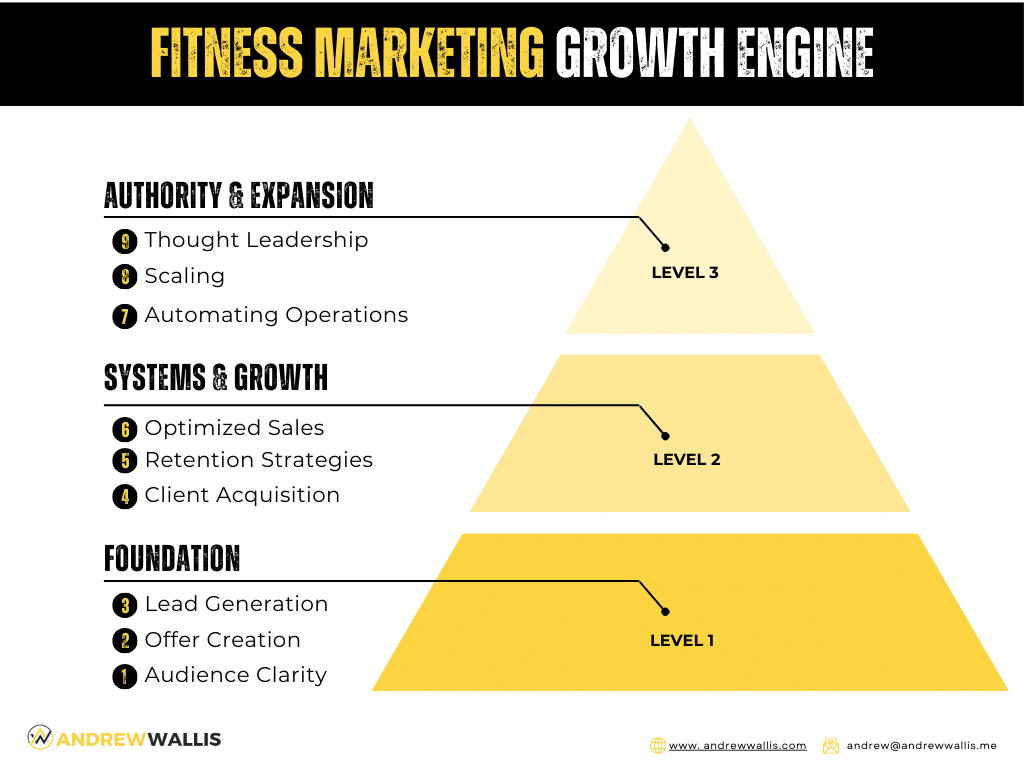
Effort vs Systems. That’s the whole game.
Depending on your stage, the same engine applies in different ways. But for a studio owner, STAY means building a predictable flow that keeps members engaged without you manually holding it together every day.
1. The 100-Day Consistent Client Retention Protocol
The first 100 days are where most retention problems either get fixed or quietly get buried.
That’s why onboarding can’t be improvised. It needs structure. It needs timing. It needs milestones. Effort vs Systems shows up here fast.
Here’s what the 100-Day Retention Protocol should include:
- Day 1-7: The “Welcome” Experience (Validation) — Confirm they made the right decision. Remove buyer’s remorse. Make the first week feel clear, supported, and intentional.
- Day 30: The “First Win” Audit (Proof of Concept) — Show them something is working. That could be attendance consistency, better energy, early body composition changes, or simply feeling more capable.
- Day 60: The “Identity Shift” (From Newbie to Community Member) — This is where they stop feeling like a visitor and start acting like someone who belongs.
- Day 90: The “Ascension” Conversation (LTV Expansion) — Don’t just let the relationship coast. This is the point to deepen the journey through the Client Retention Blueprint.

This is what structural retention looks like. Not random check-ins. Not good intentions. A repeatable onboarding and expansion system.
2. Client Results Tracking for Consistent Client Retention
If you’re not tracking client wins, you’re leaving retention to chance.
People stay when they can see progress. That progress might be fat loss, strength, energy, confidence, attendance consistency, or simply feeling back on track. If your studio doesn’t capture and reflect those wins, members forget how far they’ve come.
Results tracking is retention.
Your STAY pillar should make progress visible through reviews, milestones, and regular proof of value. That way, clients don’t have to guess whether it’s working.
3. Automated Re-Engagement for Consistent Client Retention
You should not have to manually notice every dip in attendance.
When someone starts missing sessions, slowing down, or disengaging, your system should catch it early. That’s where automated re-engagement comes in. A simple email, text, or CRM trigger can bring someone back before they become a cancellation statistic.
Tools like Glofox can help studio owners build a cleaner retention workflow without relying on memory.
That’s how structural retention works.
Not by chasing harder.
By catching issues earlier.
This is exactly where The Churn Deflector Playbook fits. It gives you the structure for spotting risk sooner and responding before a quiet dropout becomes a lost client.
4. The Consistent Client Retention Dashboard
If you want to act like a master studio owner, you need a dashboard. Not vibes. Not guesses. Numbers.
Here are the core metrics your retention system should track:
- Monthly Churn Rate — Target under 3%. If it’s above that, your studio has a structural leak.
- Average Client Lifetime — Target over 12 months. Short stays kill margin and force constant front-end pressure.
- Attendance Frequency — Know the Safe Zone vs the Danger Zone. If members usually stay when they attend 2-3 times per week, but cancellations spike below 1 session, that line matters.
What gets tracked gets fixed.
What gets guessed at usually gets worse.
Are you still managing retention from memory or a spreadsheet? Then your studio is working harder than it needs to. The STAY pillar is there to give you a safer, more predictable way to grow.
Grab the Growth Engine Scorecard to see where your retention system is failing.
If you want a blunt snapshot of where your studio is leaking clients, start there first.
The Structural Retention Matrix for Consistent Client Retention
Most studio owners don’t fail because they don’t care. They fail because they try to scale retention with more effort.
That works at first.
Then it becomes a trap.
Here’s the Structural Retention Matrix:
Level 1: Owner-Led Consistent Client Retention (Effort)
This is where most studios start. You remember names. You spot absence patterns. You message people yourself. You hold the culture together with sheer presence.
It feels personal.
It also breaks the second you step away.
Level 2: Team-Led Consistent Client Retention (Standard Operating Procedures)
This is better. Now your coaches and front-of-house team follow clear Standard Operating Procedures. Reviews happen. Check-ins happen. Re-engagement happens.
That gives you consistency.
But it still depends on humans executing perfectly every week.
Level 3: System-Led Consistent Client Retention (Growth Engine OS)
This is where stable growth happens. The Growth Engine OS turns retention into infrastructure. Onboarding flows fire automatically. Client results are tracked systematically. Attendance drops trigger action. Ascension conversations happen on time.
This is the level that protects margin and removes owner-dependence.
And if you want a studio doing £30k/month without chaos, you need Level 3.
This is also where Transferable Revenue starts to show up. A structural retention system doesn’t just keep clients. It makes the business more valuable if you ever want to sell or step back, because the revenue isn’t tied to your personality, your memory, or whether you’re physically in the building.
To move from Level 2 to Level 3, you need to master your data. My Performance Metrics Playbook provides the exact tracking templates we use in the Growth Engine OS to monitor churn and LTV.

Effort might get you to survival. Systems get you to scale.
Success in the £20k+/month bracket requires you to stop being the “Chief Everything Officer.”
When you rely on your personal effort to keep members staying, you create a dependency. If you take a holiday, retention drops. If you get sick, the community fades. That’s not a business; that’s a job you can’t quit.
Structural Revenue comes from the Stay Framework. We look at Client Lifetime Value (LTV) as a mathematical equation, not a feeling.
How do we build this?
- The Ascension Pathway: Don’t just let people “stay” on the same membership forever. Guide them. Move them from large group to small group, or add nutrition coaching. Higher LTV comes from deeper transformation. This is where the Client Ascension Playbook does the heavy lifting.
- Feedback Loops: You need a structural way to collect reviews and feedback consistently. Don’t wait for someone to cancel to ask what went wrong. Ask them while they’re winning.
- The “Stay” Content Strategy: Your content marketing shouldn’t just be for leads. It should be for your current members to reinforce their identity as a member of your studio.
- Churn Prevention Systems: Don’t wait until someone mentally checks out. Use the Fitness Business Metrics Playbook to catch risk early and respond with structure, not panic.
The Math Behind Consistent Client Retention
Let’s look at the numbers. If your average member pays £150/month and stays for 6 months, their LTV is £900.
If we fix the structural leaks using the Growth Engine OS and increase that stay to 14 months, their LTV jumps to £2,100.
You didn’t have to spend a single extra penny on Meta ads. You didn’t have to do another sales closing call. You simply built a better vehicle.
This is the difference between a studio that struggles and a studio that scales.

Step-by-Step: Building Your Consistent Client Retention Engine
If you’re ready to stop the bleeding, follow these steps:
- Audit Your Churn: Identify exactly when people leave. Is it month 3? Month 7? This tells you where the structure is failing.
- Map the Journey: Write down every single touchpoint a client has from the moment they sign the contract to month 12. If there are gaps of more than 14 days without a proactive touchpoint, that is a structural hole.
- Automate the “Low-Value” Tasks: Use Kit or your CRM to automate the “Welcome” and “Missed You” messages.
- Re-invest in Experience: Once the system is running, then: and only then: do you worry about the “coffee” and the “equipment.” The system provides the results; the perks provide the polish.
Success isn’t about working harder; it’s about building a better engine.
Quick Wins: The 24-Hour Consistent Client Retention Audit
If you want something practical to do today, start here. No overhaul. No complicated tech stack. Just a fast audit to show you where the leaks are.
1. Check your churn for the last 90 days
Don’t guess. Pull the number. If it’s over 3% monthly, you’ve got a structural issue.
2. Identify your “ghost” members
Look for members still paying but barely attending. They’re the cancellations that just haven’t happened yet.
3. Review your first 100 days
What actually happens between sign-up and day 90? Is there a clear welcome, a first-win audit, an identity shift, and an ascension conversation? Or is it mostly memory and good intentions?
4. Find your attendance danger line
At what point do members become risky? Below one visit a week? Two missed weeks? Find the pattern.
5. Pick one automation to build this week
A welcome email. A missed-session trigger. A day-30 progress check. One system beats ten good intentions.
That’s the point of the STAY pillar. Less chasing. More structure.
Are You Ready to Fix Your Growth Engine?
If you are a studio owner stuck between £8k and £30k, the “STAY” pillar is likely your biggest bottleneck. You have the skills, you have the passion, but you lack the architecture.
Stop trying to “hustle” your way to retention.
It’s time to build a Structural Revenue model that works even when you’re not in the building.
Take the first step today.
Click here to take the Growth Engine Scorecard. It takes less than 2 minutes and will give you a bespoke roadmap showing you exactly where your “STAY” pillar is breaking down and how to fix it.
If you want consistent client retention, this is the simplest next step.
FAQ: Understanding Consistent Client Retention, the STAY Pillar & Retention Systems
What is the “STAY Pillar”?
The STAY Pillar is one of the four core components of the Growth Engine OS. It focuses on Structural Retention: creating automated systems, milestones, and journey maps that increase Client Lifetime Value (LTV) without requiring constant manual effort from the owner.
What is the “Structural Retention Matrix”?
The Structural Retention Matrix is a simple way to understand how retention changes as you grow. Level 1 is owner-led, Level 2 is team-led, and Level 3 is system-led. If you want stable retention at £30k/month, Level 3 is the target because systems outperform hustle.
What is the “100-Day Retention Protocol”?
The 100-Day Retention Protocol is the structured client journey for the first phase of membership. It includes Day 1-7 validation, Day 30 proof of concept, Day 60 identity shift, and Day 90 ascension. It is designed to move clients from uncertain beginner to committed long-term member.
Why is “Structural Revenue” better than “Effort-Based Revenue”?
Effort-based revenue relies on you being “on” 24/7. Structural Revenue is built into the business design. It means your business retains members because the system is designed to keep them, not because you’re manually chasing them every day.
What is “Transferable Revenue”?
Transferable Revenue is revenue that does not depend on the owner’s personality, presence, or hustle. It comes from systems that keep clients engaged and retained even if the owner steps back, hires a manager, or decides to sell the business.
How do I know if my retention system is “broken”?
If your monthly churn is over 5%, or if you feel like you’re on a “revenue treadmill” (signing 10 new members but only growing by 1 or 2), your system is broken. A healthy “STAY” pillar creates predictable, compounding growth.
What metrics should a studio owner track for retention?
The core retention dashboard should track Monthly Churn Rate, Average Client Lifetime, and Attendance Frequency. Monthly churn should ideally stay under 3%, average client lifetime should move above 12 months, and attendance should be monitored so you know the difference between a member in the Safe Zone and one entering the Danger Zone.
What software is best for gym retention?
We recommend systems that allow for automated triggers and deep data tracking. Tools like Hapana, Glofox, or Zen Planner, integrated with an email CRM like Kit are the gold standard for structural retention. If you want to explore one external option directly, Hapana is a solid place to start.
About Andrew Wallis
Andrew Wallis is a Growth Architect for Fitness Businesses. After years in the corporate world and owning his own successful studios, he now helps studio owners move from “Founder-Dependent” chaos to “System-Driven” freedom. Through the Growth Engine OS, Andrew provides the structural blueprint for consistent, predictable, and scalable revenue.

