

The 10,000-Mile Shift: How to Find Your Freedom (Without the Hustle Trap) begins with understanding why robust fitness business systems are the secret to scaling without burnout.
Are you currently trapped in a cycle where your fitness business only grows if you personally grind for 14 hours a day?
Most fitness professionals believe that “freedom” is something you find at the end of a rainbow after years of burnout. They think if they just take on one more client, or run one more “6-week challenge,” they’ll finally have the breathing room they crave.
Here is the hard truth: Hustle is not a strategy. It’s a cage.
If you are stuck at Level 1 — Unstable Demand — the £2.5k–£5k revenue plateau — you’ve likely built a business that relies entirely on your physical presence. You are the coach, the cleaner, the marketer, and the admin. You haven’t built a business; you’ve built a high-stress job with a demanding boss (yourself).
How Fitness Business Systems Power the 5 Levels of Growth
Before you can fix the problem, you need to know where you are and where you’re going. This is the framework I use after 20 years in PT and 12 years of coaching fitness business owners. It shows the real progression from hustle to systems.
- LEVEL 1 — Unstable Demand (£0–£5k/month): Your core problem is leads. Your offer is unclear, your marketing is inconsistent, and sales feel random.
- LEVEL 2 — Broken Conversion (£5k–£15k/month): You are getting interest, but too many leads stall, ghost, or fail to buy.
- LEVEL 3 — Weak Retention (£10k–£25k/month): Clients come in, but they do not stay long enough, ascend, or increase lifetime value.
- LEVEL 4 — Owner Dependency (£20k–£50k/month): Revenue exists, but it still leans too heavily on you. If you step back, things wobble.
- LEVEL 5 — Strategic Scale (£50k–£150k+/month): The engine works. Now the focus is multiplying channels, people, and profit without chaos.
If you are a PT sitting between £2.5k and £5k, this is your reality: you do not need more hacks. You need the fundamentals fixed in the right order — Offer -> Leads -> Sales.
That is how you stop being the workhorse and start becoming the architect.
From the Isle of Man to Western Australia: The Wake-Up Call
Before I became a Growth Architect, I was a workhorse. Back in the Isle of Man, I was the guy doing the 6:00 AM sessions and finishing at 9:00 PM. I thought that was just “the way it is” in the fitness industry. I was trading every available second of my life for a paycheck that never seemed to grow as fast as my fatigue.
Then came 2011.
I moved 10,000 miles across the globe to Perth, Western Australia.
When you relocate that far, you can’t take your local reputation with you. You can’t rely on the “old boys’ network” or the clients you’ve had for a decade. I had to rebuild from zero.
But more importantly, I realised I couldn’t keep being the workhorse. I needed to make a 10,000-Mile Shift — from Workhorse to Systems Architect.
That move became the clearest proof of the shift. I could not rely on hustle anymore. I needed a business built on structure.
Offer first. Leads second. Sales third.
That is the foundational order that gets a PT out of survival mode.
Moving to Perth forced me to look at my business not as a series of sessions, but as an operating system. What I’ve seen is that freedom doesn’t come from doing more sessions better.
It comes from building the structure that allows the business to run with less dependence on you. That shift is what led me toward the Growth Engine OS — a system built on five core pillars: Demand, Capture, Nurture, Conversion, and Ascension.
The Hustle Trap: Why You Need Better Fitness Business Systems
If your business feels like a “ghost town” the moment you step away from your phone or the gym floor, you’re in the trap. Here’s what’s happening instead of growth:
- Inconsistent Leads: You wait for referrals because you don’t have a predictable way to attract high-quality clients.
- Owner-Dependence: If you get sick or go on holiday, the revenue stops. Entirely.
- Poor Conversion: You’re “winging it” on sales calls and losing thousands of pounds in potential revenue.
- The Money Pit: Spending money on Meta ads or “quick fix” marketing agencies that don’t understand the fitness landscape.
A Growth Architect doesn’t just “do” fitness; they build the systems that allow fitness businesses to run profitably. That is the role. Not more delivery. Better design.
This is also why so many hard-working owners stay stuck.
As this Entrepreneur article explains, 3 Reasons Entrepreneurs Struggle When Building Business Systems, the shift from expert to architect is where most people wobble. They are brilliant at delivery. But delivery alone does not build fitness business systems.
They understand that one well-built engine can power multiple vehicles, whether you’re a PT, a studio owner, or running a franchise.

The FREEDOM Lens: How to Architect Real Freedom
To make the shift from the grind to sustainable growth, you need a clearer lens. Not a motivational framework. A business one. The FREEDOM Lens is how I look at whether a fitness business is actually moving toward freedom or just becoming a more demanding job.
1. Foundational: Fix Offer -> Leads -> Sales
If you are a PT stuck at £2.5k–£5k, you do not have a motivation problem. You have a fundamentals problem. Usually your offer is vague, your lead flow is inconsistent, and your sales process changes every week. That creates chaos. Freedom starts when you fix the basics in the right order: Offer -> Leads -> Sales.
2. Relevant: Speak to the Real £2.5k–£5k PT Problem
This is not theory for big online brands. This is for the coach who is good at delivery but tired of income swings, last-minute cancellations, empty consultations, and the pressure of doing everything alone. The real pain is inconsistency. And inconsistency always leads to burnout.
3. Experience-Backed: Build Like an Architect, Not a Workhorse
The reason I teach this so directly is simple: I lived it. The move from the Isle of Man to Perth forced me to stop relying on reputation and start relying on systems. That was the shift. Not just geographical. Operational. It pushed me from workhorse thinking into architect thinking.
4. Emotionally Honest: Burnout Is Not a Badge of Honour
Let’s be blunt. If every month feels like starting again, that is exhausting. If your business only works when you are “on” all the time, that is not freedom. That is pressure dressed up as ambition. You should not have to earn every pound twice — once with your labour and again with your stress.
5. Direct: Keep It Simple
You do not need more complexity. You need a clearer offer, a steadier way to generate leads, and a tighter way to convert them into sales. That is the game. The rest is noise.
6. Outcome-Driven: Use the Right Next Step
Once you see the issue, the next move should be obvious. You need to know whether your bottleneck is offer, leads, or sales. That is exactly why the Growth Engine Scorecard exists. It gives you the fastest route to clarity.
7. Meaningful: Stop Being the Workhorse
The point is not to become “less busy” for the sake of it. The point is to build a business that does not consume you. To stop acting like the only moving part. To become the person who designs the engine, not just the person who keeps pushing it uphill.
When those pieces are in place, freedom becomes practical. Not theoretical.
If you want the fastest route to clarity, use the Growth Engine Scorecard and see what is actually keeping you stuck.
The “Find Your Freedom” Destination
When we talk about FIND YOUR FREEDOM, we aren’t talking about sitting on a beach doing nothing (unless that’s your goal). We are talking about two specific business outcomes: Stability + Autonomy.
- Stability: Knowing exactly where your next 10 clients are coming from. No more “hoping” for referrals.
- Autonomy: Having the systems in place so that the business functions perfectly whether you are on the gym floor or 10,000 miles away in Perth.
If you don’t have these, you don’t have a business, you have a ticking time bomb of burnout.
Do you actually know what’s broken in your business? Most trainers guess. They try a bit of Instagram, a bit of email, and a bit of “organic reach.” It’s a recipe for failure.
Grab your diagnostic report now. Use the Growth Engine Scorecard to identify exactly where your leaks are. It takes 2 minutes and gives you a roadmap to move from workhorse to strategist.
Take the Growth Engine Scorecard Here
The One Engine, Multiple Vehicles Strategy
Whether you are a solo PT or a studio owner, the core problems are the same: Inconsistent leads and owner-dependence.
The Growth Engine OS is a universal system. It is the operating system behind predictable growth, built from five core pillars: Demand, Capture, Nurture, Conversion, and Ascension. Depending on your stage, the “vehicle” might change, but the engine remains the same.
- For the PT: The engine drives high-ticket 1-to-1 or small group sessions.
- For the Studio Owner: The engine drives consistent membership sales without the owner having to be at the front desk.
- For the Strategist: The engine allows for scaling into multiple locations or online offers.
Here’s the problem: Most of you are trying to build the vehicle without the engine. You’re worried about the “paint job” (your Instagram aesthetics) whilst the “motor” (your lead flow) is non-existent.
The Growth Flywheel is the visual map for building a self-sustaining business. It shows the shift from manual hustle — where you have to push every single lead yourself — to real momentum — where your system for driving traffic, converting leads, and engaging clients starts to do the heavy lifting for you.
That is the difference between a workhorse and an architect. The workhorse pushes harder. The architect builds the flywheel so the business keeps moving.
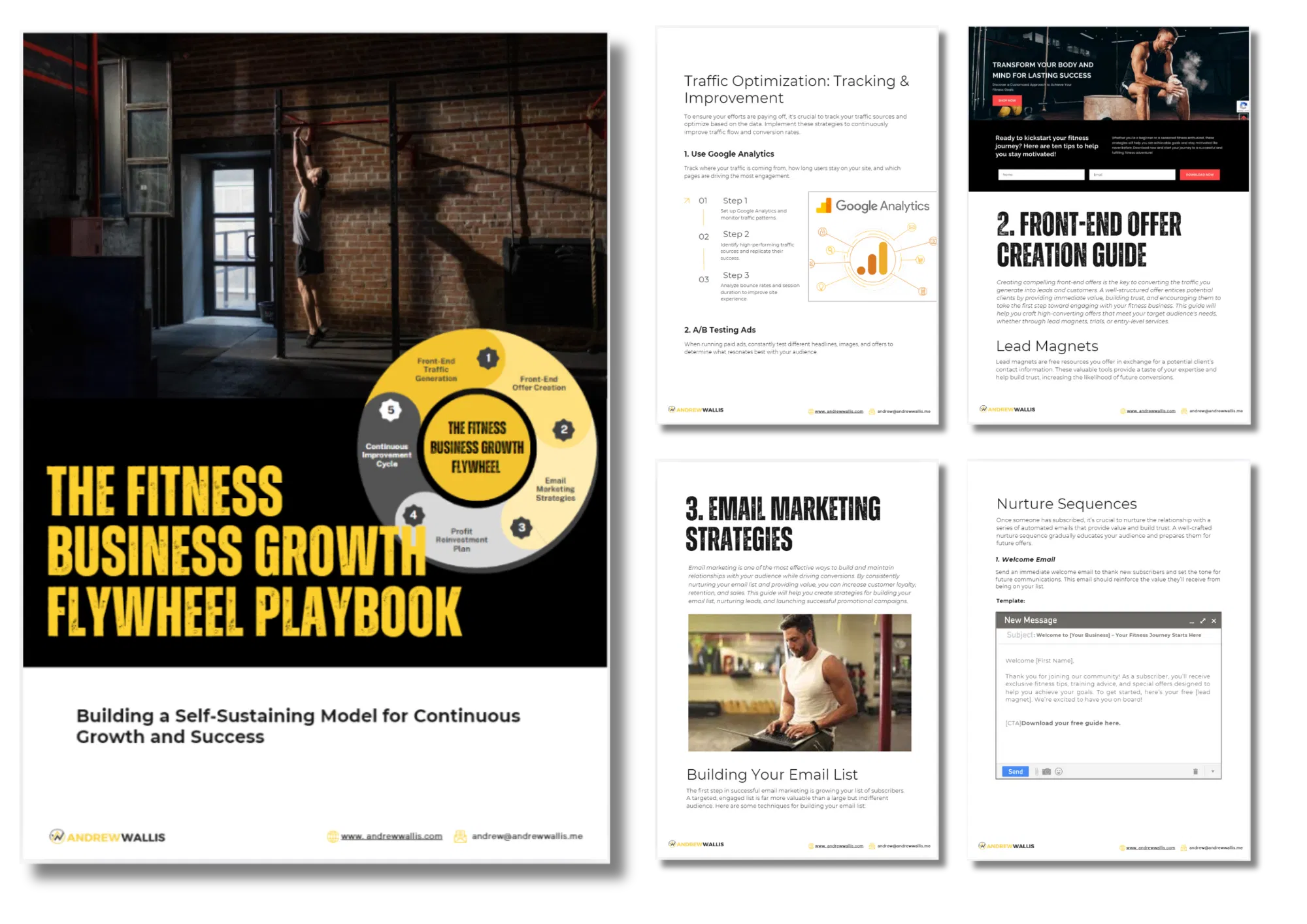
Download the Fitness Business Growth Flywheel Playbook here to start building your own self-sustaining momentum.
Step-by-Step: Moving Toward Autonomy
If you’re ready to make the 10,000-mile shift in your own business, you need to follow these steps:
- Audit Your Time: How much of your week is spent on low-value tasks that keep you busy but not protected? If it’s more than 20%, you are still operating as the workhorse.
- Clarify Your Offer Positioning: Stop selling sessions in isolation. Start packaging a clear outcome for a specific type of client. This is usually where unstable demand begins. Learn how to figure out what to sell here.
- Build a Demand System: Your online presence should create consistent interest, not just visibility. Your website and social media should help the right people find you and move into your pipeline. Check out building your online presence.
- Tighten Your Conversion Process: If your messaging is vague or your sales conversations are inconsistent, leads stall. You need language and a process that help people make decisions with confidence. Understand what your audience needs.
That is the shift in plain English: Offer -> Leads -> Sales. Fix that sequence first. Then build the rest.
Why the Systems Architect Wins in 2026
The market is saturated. In 2026, the hardest worker is not always the one who grows best. The businesses that tend to win are the ones that can generate demand, convert consistently, and operate without collapsing when the owner steps back.
The shift I made in 2011 wasn’t just geographical. It was operational. I stopped seeing myself as the service provider at the centre of everything and started acting as the Growth Architect — the person responsible for designing the system.
Are you ready to build the business so it depends less on you?
If you are stuck between £2.5k and £5k, you are usually sitting in Level 1 — Unstable Demand. What I’ve seen is that this is the stage where good coaches either build proper systems or stay trapped in overwork.
Get your Growth Engine Scorecard and see the gap in your business.
FAQ: Fitness Business Growth
How can I scale my personal training business without working more hours?
To scale without burnout, you must escape the “Hustle Trap”—a state where your income is 100% tied to your manual labor. True scaling happens when you shift from trading time for money to building repeatable systems that generate revenue whether you are on the gym floor or not.
What systems do I need to grow my fitness business to £10k/month?
To hit consistent £10k months, you need a Growth Engine OS. This involves moving from being a “Technical Trainer” to a Growth Architect. You need three core systems: predictable lead generation (Demand), a structured sales process (Conversion), and automated client fulfillment (Delivery).
How do I create a predictable lead generation system for my gym?
A predictable system replaces “hoping for leads” with a structured three-step process: Demand (getting eyes on your offer), Capture (collecting lead data through a tool like a Scorecard), and Conversion (an automated follow-up process). This creates a consistent “Engine” that runs in the background of your business.
Why is my gym’s monthly revenue so inconsistent?
Inconsistency is usually a symptom of a missing “Engine.” Without automated systems for lead flow and follow-up, you’re forced to rely on manual effort. Achieving Stability (predictable income) and Autonomy (systems that run without you) is the only way to move past the £2.5k–£5k plateau.
Can a small fitness studio really use automation and systems?
Yes. Whether you’re a solo PT or a small studio owner, the principles of the Growth Engine remain the same. The “One Engine” concept applies to any fitness business; the only thing that changes is the vehicle (your specific service), but the mechanics of traffic, leads, and sales stay universal.
How can a solo PT or small studio owner start using automation?
Automation isn’t just for big franchises. A solo PT can start by automating “low-value” tasks like appointment scheduling, initial lead follow-up, and client onboarding. By installing a “One Engine” system, you free up your time to focus on high-level strategy and delivering results for your clients.
About Andrew Wallis
Andrew Wallis is a business growth consultant and the Growth Architect for fitness businesses. From his origins in the Isle of Man to building a successful consultancy in Australia, Andrew brings 20 years in PT and 12 years of coaching to help fitness business owners move from workhorse to systems architect. Through Andrew Wallis Consultancy, he helps build the systems that allow others to do fitness profitably — using the Growth Engine OS to create stability, autonomy, and long-term growth.

