

If you are relying on a “gut feeling” to measure the health of your studio or coaching practice, you are effectively flying a plane in a thick fog without any instruments. Most fitness professionals treat their fitness business growth metrics like a scary monster under the bed: they know it’s there, but they’d rather not look at it
If you are relying on a “gut feeling” to measure the health of your studio or coaching practice, you are effectively flying a plane in a thick fog without any instruments. Most fitness professionals treat their fitness business KPIs like a scary monster under the bed: they know it’s there, but they’d rather not look at it.
Those days are officially over. If you want to scale past the £5k or £10k mark, you have to stop being a “passionate trainer” and start being a data-driven business owner.
Here is what most owners are doing instead of tracking data:
- Checking the bank balance and assuming if there is “enough” to pay the rent, they are winning.
- Judging “busyness” by how many people are on the floor at 6:00 PM on a Tuesday.
- Guessing their churn rate based on the three people who emailed to cancel this morning.
- Running Meta ads without knowing exactly how much a single lead is costing them.
The result? A business that feels like a “money pit” where you work harder every year but the profit remains exactly the same. You are essentially trapped in a growth plateau because you can’t fix what you aren’t measuring.
If you don’t know your numbers, you don’t know your business.
The Blindfold Problem: Why Intuition is Your Biggest Liability
In the previous installments of this series, we’ve built the foundation. We identified WHO you serve, how to FIND them, how to START the relationship, and how to make them STAY forever. But without the TRACK pillar, the entire Growth Engine is running blind.
According to recent industry data from ABC Fitness, high-performing clubs are seeing same-club sales trending up by 6.7-8.7%. These aren’t just the lucky ones; these are the businesses that have moved beyond “hope marketing” and into hard metrics.
When you track the right fitness business growth metrics, you gain the ability to make intentional, data-driven decisions. Instead of panicking when a few members leave, you look at the data, identify the trend, and deploy a specific system to fix it.

Grab the Fitness Business Performance Metrics Playbook here to start tracking like a pro
Step 1: Mastering Your Fitness Business Growth Metrics (The Numbers That Matter)
You don’t need a PhD in statistics to run a successful gym, but you do need to master a handful of fitness business KPIs that act as the vital signs of your business. If these are off, the business is dying.
1. Customer Acquisition Cost (CAC)
How much does it cost you to get one person to sign a contract? If you spend £500 on ads and get 10 members, your CAC is £50. If your front-end offer is only £27, you’re losing money on day one. You must know this number to understand if your marketing engine is actually efficient or just a fancy way to burn cash.
2. Lifetime Value (LTV)
This is the total amount of money a client pays you before they leave. If your average member stays for 10 months at £150/month, your LTV is £1,500. When you know your LTV is £1,500 and your CAC is £50, you can confidently spend more on marketing because you know the ROI is massive.
3. Average Revenue Per Member (ARPM Gym)
Are you maximizing the value of the people already in your building? ARPM gym metrics tell you if you’re leaving money on the table. Successful owners don’t just sell memberships; they offer supplements, workshops, or high-tier coaching that drives this number up.
Stop guessing: start measuring.
The Benchmark Reality: Planet Fitness vs. Your Business
Let’s look at the big players. Planet Fitness (2024 data) shows an industry benchmark of 6.5 visits per month per member. Why does this matter to you? Because usage is the lead indicator of retention.
If your members are visiting less than 1.5 times per week, they are a “churn risk.” By tracking attendance as a core KPI, you can intervene before they send that cancellation email.
- Low visits = High Churn.
- High visits = High LTV.
It really is that simple. Most trainers wait until the member stops paying to realize there was a problem. The TRACK pillar allows you to see the problem coming 30 days in advance.
Step 2: Financial Health and The Cash Flow Trap
Most fitness businesses fail not because they lack members, but because they run out of cash. You can have a “busy” gym and still be broke if your margins are thin and your tracking is non-existent.
You need a dashboard that shows you:
- Monthly Recurring Revenue (MRR): The predictable “safe” money.
- Churn Rate: The percentage of people leaving each month.
- Profit Margin: What you actually keep after the coaches, rent, and Meta are paid.
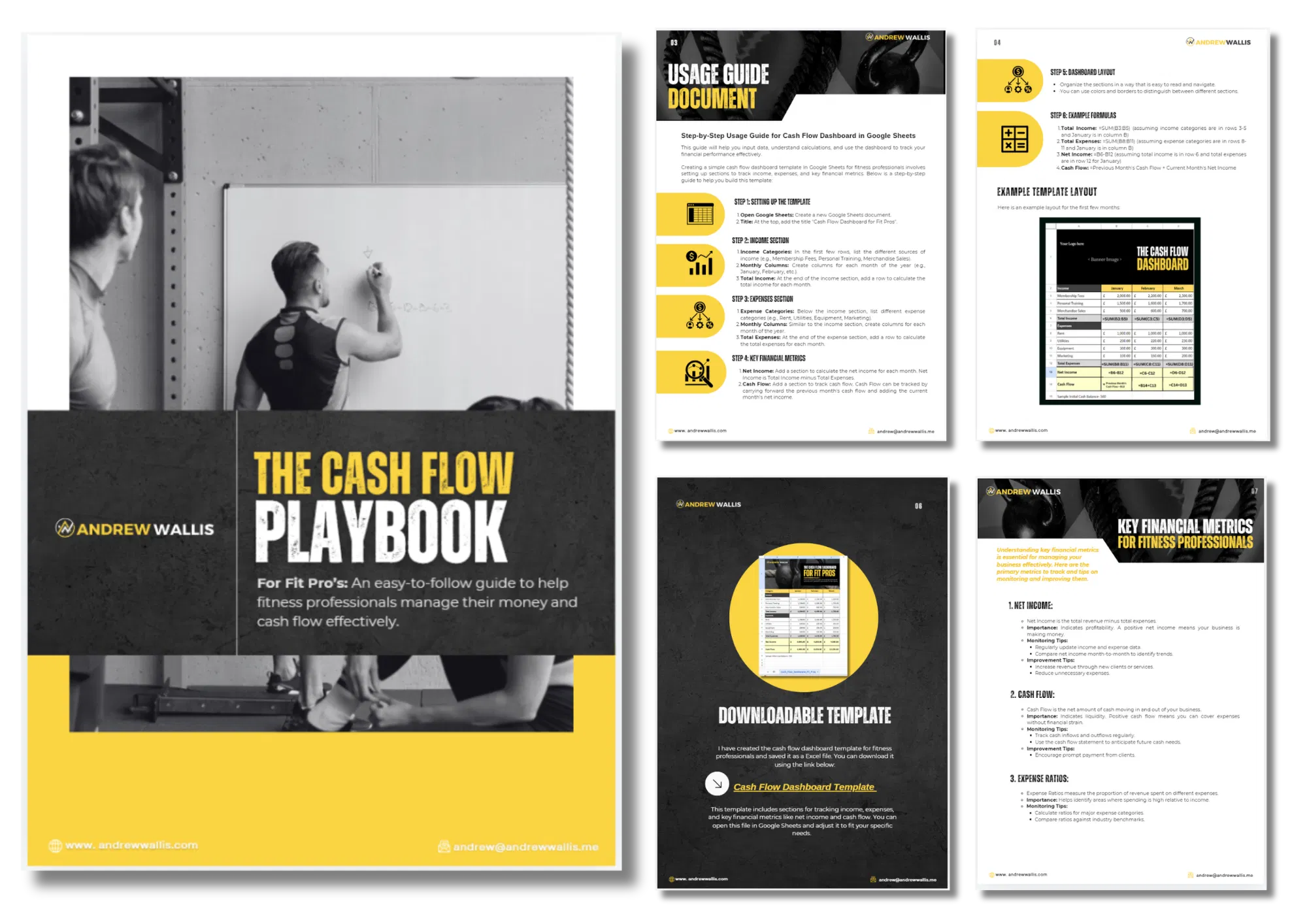
If you aren’t reviewing these weekly, you aren’t “in business”: you’re just self-employed with a very stressful hobby. Successful studio owners treat their weekly metric review like a sacred ritual.
Download The Cash Flow Playbook for Fit Pros and take control of your profit
Step 3: Putting It All Together – The Growth Engine OS
This post concludes our Growth Architect Blueprint series. Over the last few weeks, we have dismantled the “standard” way of running a fitness business and replaced it with a predictable engine.
Now here’s the part most owners miss.
If your fitness business is doing £20k–£150k/month, your constraints are almost never “more leads” anymore. They’re usually the next two levels of the Growth Engine OS™:
- Level 4 (£20k–£50k/month): Owner Dependency — your SOPs and team aren’t tight enough, so everything still needs you.
- Level 5 (£50k–£150k+/month): Strategic Scale — your infrastructure isn’t built for volume, so growth creates chaos.
That’s exactly why TRACK matters at the higher levels.
At Level 4 and 5, TRACK becomes your diagnostic tool—the dashboard that tells you:
- Are you the bottleneck (owner dependency), or…
- Is the infrastructure missing (strategic scale)?
Because if you don’t have a dashboard, you’ll do what most owners do:
- Assume your “team isn’t good enough” when you actually have no SOPs.
- Assume you “need a manager” when you actually need clearer numbers and accountability.
- Assume “growth isn’t for you” when you actually need better infrastructure.
TRACK is the dashboard you need to build an owner-independent business. Not a hustle-hard business. Not a “DM me for prices” business. A business that runs—whilst you’re not there.
If you want the full roadmap across stages, read Scaling a Fitness Business: The One Engine, Three-Stage Roadmap.
And if your tracking shows retention and churn are the real leak, go revisit the STAY pillar—because scale without retention is just pouring water into a bucket with holes.
Let’s recap the architecture:
- WHO: You identified a specific, profitable niche so you aren’t shouting into the void.
- FIND: You built a multi-channel lead generation faucet to stop the “referral addiction.”
- START: You implemented a high-conversion sales process that feels like help, not a pitch.
- STAY: You created an “indoctrination” system that turns new members into lifelong fans.
- TRACK: You installed the dashboard to ensure every part of the engine is performing at 100%—and to diagnose Level 4 Owner Dependency and Level 5 Strategic Scale.
One engine → multiple vehicles. Depending on your stage, TRACK either helps you stabilise the basics—or it becomes the operating dashboard that makes the business owner-independent.
The era of “gut feeling” is officially dead. Welcome to the era of the Growth Architect.
FAQ: Frequently Asked Questions about Fitness Business Growth Metrics
What is the most important fitness business growth metric to track first?
The most important KPI is Customer Acquisition Cost (CAC). If you don’t know how much it costs to buy a customer, you cannot scale your marketing safely.
Why is ARPM gym important?
ARPM (Average Revenue Per Member) is important because it measures the efficiency of your internal sales and upselling. Increasing ARPM is often easier and more profitable than finding new members.
How often should I track my gym growth metrics?
You should track lead flow and sales daily, retention and attendance weekly, and financial profit/loss monthly.
What is a good churn rate for a fitness studio?
In the boutique fitness world, a churn rate of 3-5% is considered excellent. Anything over 7-10% indicates a major problem with the STAY pillar of your business.
How do I calculate Lifetime Value (LTV)?
To calculate LTV, multiply your Average Monthly Revenue per Member by the Average Number of Months a member stays with you.
Final Thoughts: Your Next Move
You have the blueprint. You have the pillars. Now, you have a choice. You can go back to the “guesswork” and the stress of not knowing where your next client is coming from, or you can start building your engine.
Are you ready to see the truth about your business?
The first step for every fitness professional I work with is the Growth Scorecard. It takes less than 3 minutes and will show you exactly which pillar of your business is currently broken.
Take the Growth Scorecard here and get your custom growth roadmap today.

The Growth Architect Blueprint series is designed to take you from a struggling technician to a thriving business owner. If you missed any of the previous steps, go back and read them now( your future self will thank you.)

