

Are you honestly satisfied with just “keeping” your clients, or are you actually building a business that scales? Understanding every stage of the fitness client journey is the only way to move from a stressed-out “Workhorse” to a profitable “Growth Architect” who understands how to maximize every lead.
Most gym owners are trapped in a defensive mindset.
You spend your entire week worrying about who might cancel, who hasn’t shown up in three days, and how to “save” a £50-a-month membership.
That is a poverty-level strategy.
If your only goal is retention, you’re playing the game not to lose. Successful Growth Architects play to win.
Here is what most trainers are still doing in 2026:
- Offering a single, flat-rate membership and hoping people stay forever.
- Waiting for the client to ask for more help instead of leading them.
- Ignoring the data that shows exactly when a client is ready to level up.
- Treating every member the same, regardless of their goals or budget.
The result?
Your revenue hits a glass ceiling. Your profit margins are razor-thin whilst your expenses continue to climb.
You’re working harder for the same amount of money you made three years ago. It’s a slow death by stagnation.
Why “Retention” Is a Low-Bar Goal in the Fitness Client Journey
Let’s get one thing straight: Retention is the floor, not the ceiling.
Research published in Harvard Business Review highlights that increasing customer retention rates by 5% increases profits by 25% to 95%. But in the fitness client journey, “STAY” is only one part of the Growth Engine OS.
In my Ultimate Guide to Client Longevity, I broke down the STAY (Client Retention) framework.
But “STAY” is only one part of the Growth Engine OS.
Retention is about stopping the bleed. Ascension is about building the muscle.
If you want to build a predictable, high-profit fitness business, you must move beyond the “Leaky Bucket” mentality.
You need Ascension Pathways.
An Ascension Pathway is a structured journey that moves a client from a low-barrier entry point to a high-value, high-impact premium service.
It’s about increasing the Lifetime Value (LTV) of every single person who walks through your door.
Instead of fighting for £50 a month, you should be architecting a journey that turns a £50 lead into a £5,000-a-year raving fan.
The Growth Engine OS: Mapping Your Fitness Client Journey
Whether you’re a New & Struggling PT or a Studio & Gym Owner doing £10k+ a month, the system is exactly the same.
The scale changes, but the architecture doesn’t.
I see too many owners trying to reinvent the wheel every time they launch a new service.
Stop it.
You need one engine: a predictable system for acquisition and retention: that powers multiple vehicles (your different service tiers).

The Ascension Pathway is the roadmap for those vehicles.
If you don’t have this mapped out, you’re essentially leaving your revenue to chance. And hope is not a business strategy.
Think your business is ready for the next level?
Take the Fitness Business Growth Scorecard**** right now to see where your “Ascension Gaps” are hiding. It takes less than 2 minutes and will give you a clear roadmap.
Step 1: The Entry Point (The Front-End Offer)
Your journey doesn’t start when someone signs a 12-month contract. It starts at the first point of value.
Too many gym owners try to “marry” the prospect on the first date. They push the long-term commitment before the trust is built.
In 2026, the market is too sceptical for that.
Your Front-End Offer (FEO) should be a “Low-Tension” entry.
- A 21-day transformation.
- A paid 6-week challenge.
- A low-cost diagnostic assessment.
The goal here isn’t profit: it’s acquisition and proof.
You’re moving them from “Stranger” to “Client” as fast as possible. Once they are in your ecosystem, you have the permission to lead them.
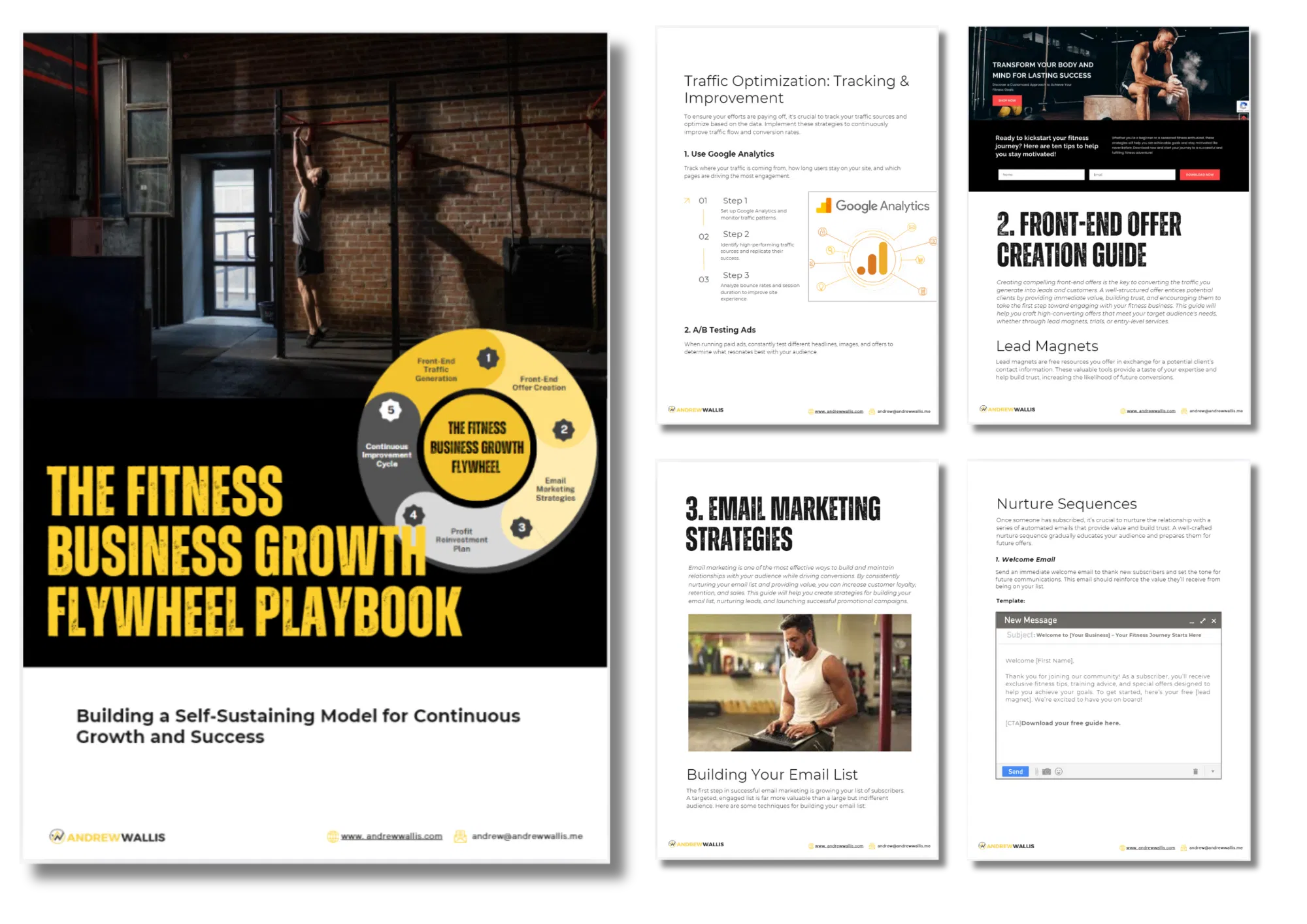
Stop waiting for leads. Download the Fitness Business Growth Flywheel Playbook and build your own customer acquisition machine.
Step 2: The Continuity Phase (The “STAY” Stage)
Once the challenge or trial ends, most trainers drop the ball. They say, “So, do you want to keep going?”
That’s not leadership. That’s begging.
The Continuity Phase is where you move them into your “Core” offering. This is your bread-and-butter membership.
But here’s the secret: The Core offering should never be the final destination.
During this stage, you are looking for “Ascension Triggers”:
- Plateaus: They’ve hit a wall and need more specific programming.
- Speed: They want results faster than the group environment allows.
- Status: They want the proximity to the “Head Coach” or expert.
- Complexity: Their goals have shifted from “lose weight” to “run a marathon” or “compete.”
If you aren’t identifying these triggers, you are leaving money on the table.
Step 3: The Ascension (High-Ticket & VIP)
This is where the real profit is made.
Every gym has a “Top 5%” of clients. These are the people who have the most disposable income and the highest level of commitment.
They don’t want “cheap.” They want “best.”
If you don’t offer a high-ticket Ascension path, these clients will eventually leave you to find someone who does.
Ascension options include:
- Semi-Private Training: Moving from large group to 1:4.
- 1-on-1 Performance Coaching: High-touch, high-accountability.
- Specialized Tracks: Nutrition-only coaching, injury rehab, or sport-specific prep.
- Retreats & Experiences: High-margin, community-building events.
Stop thinking about what people can “afford” and start thinking about the value you can provide.

Are you charging enough for your expertise? If you’re still competing on price, you’re losing.
Download the Fitness Business Pricing Strategy Playbook**** and fix your margins before you burn out.
Mapping the “Value Ladder” vs. The “Leaky Bucket”
Let’s look at the numbers. The math of Ascension is undeniable.
| The Leaky Bucket (Old Way) | The Ascension Pathway (Growth Engine) |
|---|---|
| Flat-rate £50 membership | £197 6-Week Challenge (Entry) |
| High churn (3-6 months) | £79/mo Membership (Continuity) |
| Constant need for new leads | £250/mo Semi-Private (Ascension) |
| LTV: £150 – £300 | LTV: £1,500 – £4,000+ |
Which business would you rather own?
The trainer who is “winning” in 2026 isn’t the one with the most followers; it’s the one with the highest LTV.
When you increase LTV, you can afford to spend more to acquire a client. The person who can spend the most to acquire a customer wins.
Step 4: Systematize the “Next Step” Conversation
Ascension doesn’t happen by accident. You need a system.
In the Andrew Wallis Consultancy framework, we use the “90-Day Review” as the primary vehicle for Ascension.
Don’t wait for them to get bored.
Every 90 days, you sit down with your clients (or have your team do it) and ask three specific questions:
- What is the next goal? (The vision has changed since day 1).
- What is the biggest roadblock right now? (Usually something your higher-tier service solves).
- How fast do you want to get there? (Speed is the ultimate upsell).
If you aren’t having these conversations, you aren’t a coach: you’re a facility provider.
And facility providers are easily replaced by the cheaper gym down the road.
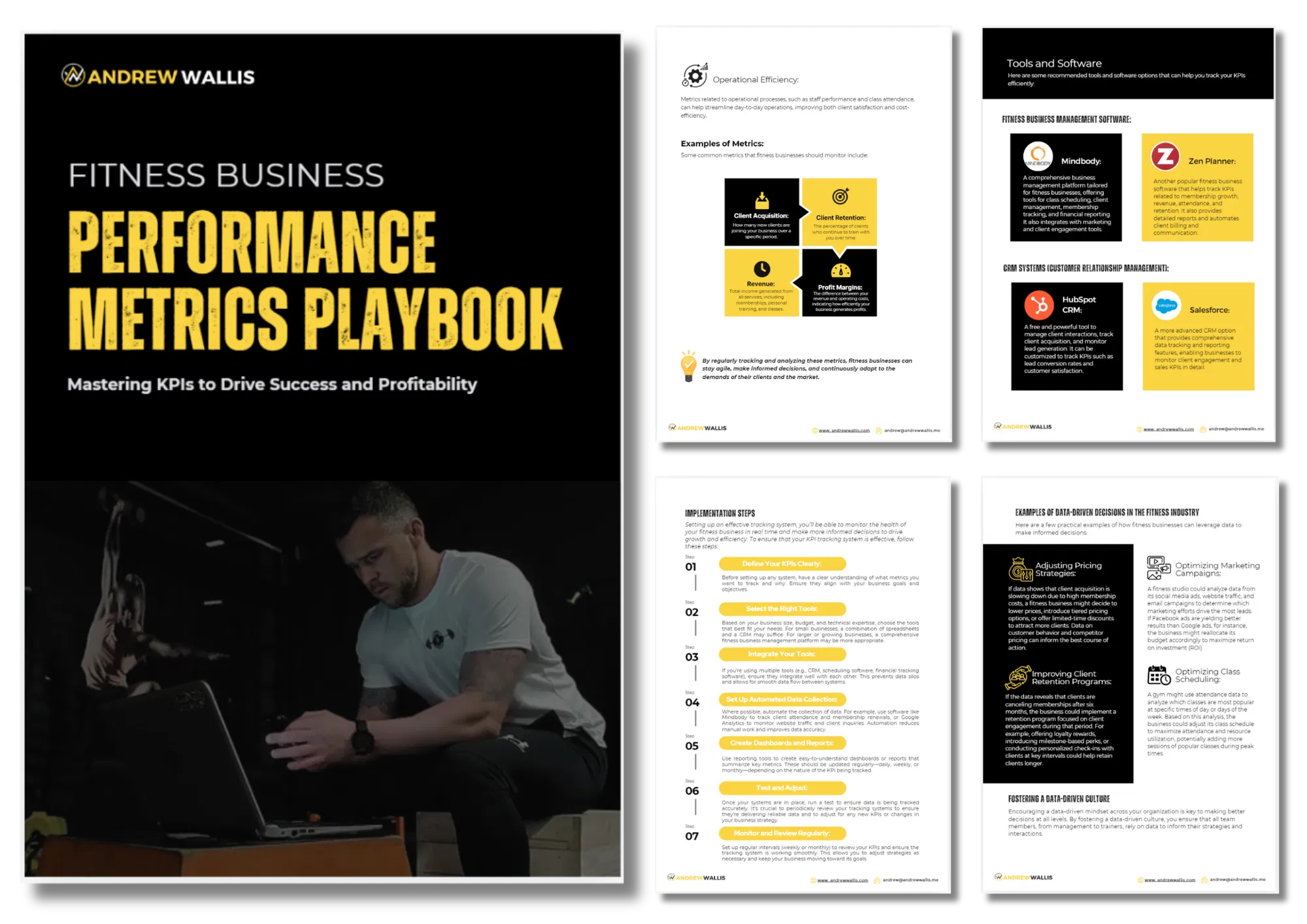
Stop flying blind. Get the Fitness Business Performance Metrics Playbook and start tracking the numbers that actually matter.
Stop Guessing. Start Building.
The “Danger Zone” for most fitness businesses is the 90-to-180-day mark. This is where the novelty wears off and the client starts looking for the exit.
Ascension Pathways give them a reason to stay. By always providing a “Next Step,” you keep the journey fresh and the value high.
If your revenue is stagnant, it’s not because you need more leads. It’s because you haven’t built the “Pathways” to maximize the leads you already have.
Ready to stop the “Reset Problem” and start scaling?
Step 1: Get your Growth Score. Find out exactly where your business is leaking cash.
Step 2: Review your pricing. If you don’t have a service that costs at least £250/month, you don’t have an Ascension Pathway.
Step 3: Implement the 90-day review system immediately.
The market doesn’t reward hard work; it rewards well-engineered systems.
Build your engine.
FAQ: Ascension Pathways for Fitness Professionals
What is an Ascension Pathway in fitness?
An Ascension Pathway is a strategic model that moves clients from lower-priced, entry-level services to higher-priced, more comprehensive programs as their needs and commitment levels grow.
Why is Ascension more important than just Retention?
Whilst Retention focuses on keeping a client from leaving, Ascension focuses on increasing the value you provide (and the revenue you generate) from that client. It significantly boosts Lifetime Value (LTV) and business profitability.
Can small-scale Personal Trainers use Ascension Pathways?
Absolutely. In fact, it’s easier for PTs. You can move clients from one-off sessions to monthly blocks, then to specialized “High-Performance” packages that include nutrition, mindset, and 24/7 support.
How often should I offer an “Ascension” to a client?
The best time is during structured reviews, typically every 90 days. However, “Ascension Triggers”: like hitting a specific fat-loss goal or expressing interest in a new challenge: can happen at any time.
What if my clients can’t afford a more expensive service?
Some won’t. And that’s fine. Ascension is about identifying the 10-20% of your database who want and can afford more help. You don’t need everyone to ascend; you just need a clear path for those who are ready.
About Andrew Wallis
Andrew Wallis is a Growth Architect for fitness businesses. After years of navigating the transition from corporate roles to owning high-performing fitness studios, Andrew now helps gym owners and PTs implement the Growth Engine OS. His consultancy focuses on moving owners from “Workhorse” to “Architect” by building predictable systems for lead gen, conversion, and long-term client ascension.

