

Are you tired of running a business that feels like a hamster wheel, where every new client you sign simply replaces the one who walked out the back door yesterday?
If you want to escape the “revolving door” and build a business that actually scales, you need to master gym member retention. Most gym owners and personal trainers focus entirely on lead gen, but the real secret to long-term growth is keeping the clients you already have.
If your “marketing strategy” is just a desperate attempt to outrun your cancellation rate, you don’t have a growth problem. You have a STAY problem.
Whilst most “gurus” are screaming about lead generation and Facebook ads, the successful 5% are focusing on the STAY (Client Retention) pillar of the Growth Engine OS™. They understand that it’s ten times cheaper to keep a client than to find a new one.
In this guide, I’m going to show you how to stop being a Workhorse who hopes people stay, and start being a Growth Architect who builds systems that ensure they never want to leave.
The Leaky Bucket vs. The Stable Vault
Think of your fitness business as a bucket.
Most trainers spend all their time, energy, and money pouring water (new leads) into the top. But because their retention systems are non-existent, the bucket is full of holes. The water pours out just as fast as it goes in.
This is what I call Level 3 of the Growth Engine OS™: Weak Retention. It leads to the Reset Problem, starting every month at zero, wondering if you’ll make rent because three “long-term” clients just ghosted you.
Instead, we want to build a Stable Vault. This is where your revenue is Predictable Revenue. You aren’t guessing; you’re growing.
STOP focusing entirely on the “FIND” phase, START mastering the “STAY” phase.

(Visual Suggestion: A “Leaky Bucket” vs. a “Stable Vault” diagram illustrating the difference between high-churn and high-retention business models.)
Why Most Gyms Lose Members After 90 Days
Have you noticed the 90-day “danger zone”?
It’s that moment when the initial “new year, new me” dopamine wears off. The soreness isn’t “good” anymore; it’s just annoying. The results aren’t coming as fast as they did in week two.
If you don’t have a system to catch them here, they are gone.
Most trainers rely on “being nice” or “checking in.” That is not a system. That is a hope-based strategy.
Here is what’s actually happening:
- The Onboarding is weak: They don’t feel like they belong yet.
- The Journey is invisible: They don’t know what comes next after the first 12 weeks.
- The Progress is untracked: If they don’t see the numbers move, they assume nothing is happening.
If you’re still relying on your personality to keep clients, you’re hitting a ceiling. You can’t scale personality. You can scale systems.
Check out where your business stands right now. Grab your Growth Engine Scorecard to see if your retention is a ticking time bomb.
Strategy 1: The Onboarding & Indoctrination System
The first 30 days of a client’s journey dictate the next 30 months.
Stop treating onboarding as a simple “sign the waiver and here’s your program” session.
You need an Indoctrination System. This is where you transform a “customer” into a “member of the tribe.”
What a World-Class Onboarding looks like:
- The Day 0 Welcome: An automated (but personal) video message the moment they pay.
- The Success Roadmap: A physical or digital document showing exactly what their first 90 days look like.
- The Community Bridge: Introducing them to three other members immediately so they have “gym buddies.”
- The Quick Win: Ensuring they achieve a tangible result (better sleep, more energy, first 2kg lost) within the first 10 days.
You aren’t just selling fitness; you’re selling an identity. If they don’t adopt the identity of “someone who trains at your gym” within 30 days, they will quit the moment life gets busy.

Need a hand getting a grip on client retention? My Client Retention Blueprint has the proven strategies and tools you need to boost client loyalty and build lasting relationships.
Strategy 2: The STAY (Client Retention) Journey & Ascension Pathways
Why would someone stay for year two if it looks exactly like year one?
This is where the Growth Engine OS™ separates the pros from the amateurs. You must have Ascension Pathways.
Most trainers sell “sessions.” Growth Architects sell “transformations.”
When a client finishes their initial 12-week “Kickstart,” what’s next? If the answer is “more of the same,” you’re boring them to death.
Instead, map out the journey:
- Phase 1 (0-90 Days): The Foundation (Fat loss, movement mechanics).
- Phase 2 (3-9 Months): The Build (Muscle gain, strength benchmarks).
- Phase 3 (9-18 Months): The Mastery (Advanced skills, performance goals).
- Phase 4 (18+ Months): The Lifestyle/Legacy (Mentoring others, community leadership).
Move clients from sessions to high-value outcomes
Here’s the problem: if you price and position around sessions, you trap yourself in a low-ceiling model. You sell time. You defend price. You create dependency on your diary.
STAY (Client Retention) gets stronger when clients buy into an outcome, not a calendar slot.
What doesn’t work vs. what does work:
| Workhorse offer | Growth Architect offer |
|---|---|
| “3 sessions per week” | “12-week Fat Loss Kickstart” |
| “Monthly PT package” | “Strength & Confidence Build Phase” |
| “Pay for more sessions” | “Progress into the next milestone” |
| “Train with me” | “Become the person who achieves X” |
A typical revenue jump looks like this:
- Sessions model: 8 sessions per month at £35 = £280/month
- Outcome model: 12-week programme at £597-£997 = £199-£332/month equivalent before upsells
- Ascension path: Client completes Kickstart, moves into a £249-£399/month coaching or hybrid membership
- 12-month value: One client can move from £840-£1,120 in random session sales to £2,988-£4,788+ in a structured journey
That is the shift.
You stop reselling hours. You start engineering value.
By showing them the “Next Level,” you give them a reason to keep paying. You’re moving them from a transaction to a relationship.
If your offers still feel like disconnected packages, grab the Growth Engine Scorecard and find the bottleneck in your STAY system.
Strategy 3: STAY (Client Retention) Tracking — Data Over Vibes
How many of your members are at “high risk” of leaving right now?
If you can’t answer that with a number, you’re flying blind. You cannot manage what you do not measure.
Stable Revenue comes from knowing your numbers. You need a Retention Tracking System that flags “at-risk” members before they send the “I need to take a break” email.
The Key Metrics you need to track:
- Attendance Frequency: If they drop from 3 times a week to 1, they are 80% likely to quit within 21 days.
- Progress Milestones: Are they hitting PRs? Are they losing inches?
- Engagement Score: Are they opening your emails? Are they active in your Facebook group?
Stop waiting for them to quit, proactively re-engage them.
A simple text that says, “Hey, missed you on Tuesday, everything okay?” is worth £1,000s in lifetime value, but only if you have a system to tell you when to send it.
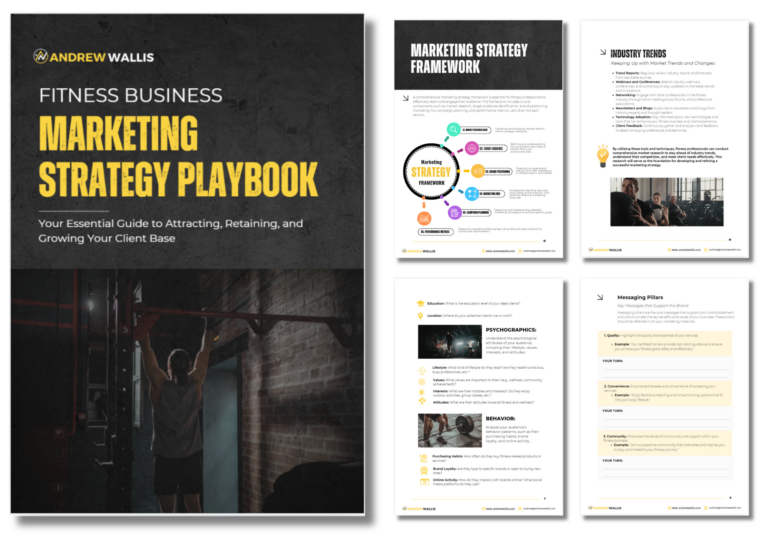
Need a hand setting up your tracking? My Fitness Business Marketing Strategy Playbook has the templates you need to start measuring what matters.
Community Systems: Not Just “Being Nice”
People come for the results, but they stay for the people.
However, “Community” isn’t just a buzzword you put on your website. It’s a series of Community Systems.
How to systematise belonging:
- The Monthly Challenge: Create a common goal that everyone works toward.
- The Social Calendar: Quarterly events that have nothing to do with lifting weights.
- The Recognition Engine: Publicly celebrating member wins (not just the “biggest losers,” but the “most consistent” or “newest PR”).
When a member feels like they are part of something bigger than a workout, leaving the gym feels like leaving their friends. That is the ultimate retention hack.
Moving from Workhorse to Growth Architect
Building a high-retention gym doesn’t happen by accident. It happens by design.
Workhorse vs. Growth Architect — STAY (Client Retention) edition
| Personality-led Workhorse | System-led Growth Architect |
|---|---|
| Keeps clients through charisma | Keeps clients through repeatable systems |
| Only notices risk when someone complains | Flags attendance red alerts early |
| Sells sessions one month at a time | Maps clients into long-term ascension pathways |
| Relies on memory and vibes | Uses data, milestones, and automation |
| Creates owner-dependence | Builds a business that runs with structure |
| Feels every cancellation personally | Treats churn as a fixable systems issue |
STOP:
- Reacting to cancellations after they happen.
- Depending on your charisma to keep people.
- Ignoring the data because “you know your clients.”
START:
- Building a 90-day Indoctrination system.
- Mapping out 12-month Ascension Pathways.
- Using a CRM to track attendance and engagement.
This is how you build a business that provides freedom, not just a job that provides a headache.
When you master the STAY pillar of the Growth Engine OS™, your business becomes a Stable Vault. Every new client you find through your lead generation firehose becomes a long-term asset, compounding your growth month after month.
Architect’s Note: Longevity is tactical, but retention is structural. To move from individual tactics to a full retention engine, view the STAY Pillar Master Guide.

Be the first to access my Small Group Coaching Program for Fitness Professionals. Sign Up for my Wait List
3 Quick STAY (Client Retention) Wins You Can Implement This Week
Need momentum fast? Start here.
- Create an attendance red-flag rule: If a client misses 2 sessions or classes in 7 days, trigger a personal check-in text the same day.
- Add a “what happens next” conversation: Before every client finishes their current package, book a review that shows their next milestone and offer.
- Celebrate one measurable win publicly each week: Use your WhatsApp group, email, or member board to reinforce progress and belonging.
These are simple.
They are not small.
Quick wins build retention momentum because they increase visibility, accountability, and connection immediately.
If you want the full system behind these quick wins, start with the Growth Engine Scorecard and see which part of your retention engine is leaking.
Summary: Your Retention Checklist
- Audit your Onboarding: Does it feel like an event or a chore?
- Identify the “Danger Zone”: When do most of your clients actually quit? (Hint: It’s usually weeks 8-12).
- Install a Tracker: Use a simple spreadsheet or CRM to flag low attendance.
- Map the Journey: Write down exactly what happens to a client after their first 6 months.
If you want to stop the “Reset Problem” and finally build a business that scales, it’s time to see where your gaps are.
Click here to take the Growth Engine Scorecard and get your custom growth roadmap.
FAQ: STAY (Client Retention) for Gyms
What is STAY (Client Retention)?
STAY (Client Retention) is the part of the Growth Engine OS™ focused on keeping clients longer, increasing lifetime value, and reducing owner-dependence. It is the system that turns one-off signups into predictable recurring revenue.
What is a good retention rate for a gym?
In the boutique fitness world, you should aim for a monthly attrition rate of less than 5%. If you’re losing more than 1 out of 20 members every month, your “bucket” has significant holes that need fixing.
How do you calculate gym member churn?
Divide the number of members who left during a month by the total number of members you had at the start of that month. Multiply by 100. (e.g., 5 departures / 100 members = 5% churn).
What is LTV in a gym business?
LTV is Lifetime Value. It is the total revenue a client generates before they leave. LTV rises when retention improves because members stay longer, buy more, and are more likely to refer others.
Why does retention improve profits so much?
Retention improves profits because keeping an existing member is cheaper than constantly replacing them. A 5% increase in retention is often associated with a 25% to 95% increase in profits because you protect revenue, increase LTV, and reduce acquisition pressure.
What is the 90-day drop-off?
The 90-day drop-off is the industry-wide phenomenon where member motivation plummets after three months. This is usually because the “novelty” has worn off and they haven’t yet seen the “life-changing” results they expected.
How can I improve my gym’s community?
Community is built through shared struggle and shared celebration. Implement monthly challenges, member-of-the-month spotlights, and non-fitness social events to move members from “strangers” to “supporters.”
Does automated communication hurt retention?
Not if it’s done right. Automation should be the “trigger” for a human connection. Use automation to notify you to send a personal text, or use it to send valuable educational content that helps the client reach their goals.
What is Hapana used for in retention?
Hapana is a gym management platform that can help you spot retention risks through attendance trends, class bookings, and engagement signals. It is useful because it gives you red-flag visibility before a member silently drifts away.
About Andrew Wallis
Andrew Wallis is the founder of Andrew Wallis Consultancy and the Growth Architect for Fitness Businesses. After building his career in the corporate world and then working hands-on in fitness, he saw the same pattern again and again: talented fitness business owners were working flat out, wearing every hat, and still stuck with inconsistent leads, poor conversion, and owner-dependence.
So he built a better way.
Through the Growth Engine OS™, Andrew helps fitness businesses create a predictable flow of clients, conversions, and retention using one engine → multiple vehicles. Depending on your stage, that same system applies whether you’re a new PT trying to get traction, a coach stuck at £2.5k-£5k/month, or a studio or franchise operator trying to scale without chaos.
His core philosophy is simple: you do not need more random tactics — you need a system. That’s why his work focuses on practical frameworks like the Growth Engine, detailed Playbooks, the Growth Engine Scorecard, Power Hour Coaching, and 1-Day Marketing Intensives built specifically for the fitness industry.
Andrew’s approach is straight-talking, strategic, and grounded in what actually works in 2026 — not recycled internet fluff from 2018. He helps trainers and gym owners stop acting like the business bottleneck and start building a company that creates predictable revenue, stable income, and more freedom.
If you want to see what’s holding your business back right now, get your Growth Engine Scorecard.

