
The Dream 100 for gyms and studios: lumpy mail, QR codes and follow-up that open the right doors
 By Andrew Wallis · Published 28 October 2026 · 12 minute read
The short answer
Pick the 25 local businesses who could send you a steady stream of members. Send each one something they can't ignore, with a QR code to a page made for them. Then follow up until you get a yes or a clear no.
Why the right doors stay shut
Some of your best new members could come through other businesses: the employer with 200 staff, the physio with a waiting list, the running club, the school. One yes from the right person can bring in more people than a month of ads.
But those people are busy and well protected. Your email gets filtered. Your call reaches a receptionist. Your flyer goes in the recycling before the decision maker sees it.
So you fall back on what you can control: another ad, another offer, another post. It's tiring, and it leaves you paying for every new member.
It shouldn't come down to who has the biggest ad budget. A good gym or studio deserves to be the one local employers and health professionals recommend.
The answer isn't to shout louder. It's to pick fewer people, and make it impossible for them to forget you. That's how we won a boot camp contract with a single flip-flop.
What the Dream 100 is
The Dream 100 comes from Chet Holmes, who sold advertising for Charlie Munger's magazine business and wrote about it in The Ultimate Sales Machine (opens in a new tab) (2007). He found that 167 advertisers spent most of the money in his market.
So he stopped chasing everyone. He sent those 167 something in the post every couple of weeks, with regular phone calls.
For about four months, nothing happened. Then the deals started coming in. The lesson: the right people are busy, not uninterested. They need to see you enough times before you become real to them.
Russell Brunson brought it to online marketing in Traffic Secrets (opens in a new tab) (2020). His version: list the people who already have your ideal customers' attention, then "work your way in" through relationships and "buy your way in" with targeted ads.
For a gym or studio, you don't need 100. Twenty-five local businesses, chosen well and followed up properly, is plenty. The plan has three steps:
- Pick your 25, and decide what you'll offer them.
- Send something they can't ignore, with a QR code to a page made for them.
- Follow up until you get a yes or a clear no, with reminders that run on their own.
Allow a day to set it up, then about two hours a week.
Step 1: Pick your 25
Look for businesses whose people are the people you help:
- Employers with 50 or more staff, especially offices, schools, councils and hospitals.
- Health professionals: physios, osteopaths, chiropractors, GPs' practices and dietitians.
- Clubs and groups: running clubs, sports clubs, parents' groups, Rotary and the Chamber of Commerce.
- Businesses with the right customers: salons, cafés, running and bike shops, maternity and children's shops.
Ask your members where they work, and which local businesses they'd recommend. A member on the inside is the warmest way in.
For each business, find the decision maker by name: the owner, the head of HR or the club secretary. A named person is the difference between mail and junk mail.
At bigger employers, note a second person too, such as a wellbeing lead or a staff member who's already a member. The decision maker signs off; the champion makes it happen.
An AI assistant such as ChatGPT can speed up the research: who runs the business, what they've posted lately, what matters to them. Check what it tells you before you use it.
Then rank your list. Your top ten get the most personal approach, including the lumpy mail. The rest get the same follow-up, with lighter touches.
Decide what you're offering them
Your Dream 100 doesn't care about your memberships. They care about their staff, their clients and their own business. So lead with something that helps them:
- A free 30-minute talk for their staff or members, such as a lunch-and-learn. See how to run a workshop that fills your diary.
- A staff challenge or a corporate boot camp before work.
- A partnership: a referral route, a joint offer, or a guide you write for their customers.
Make it free or low-risk to say yes to. The memberships come later, from the people you meet.
Step 2: Send something they can't ignore
"Lumpy mail" is post with something in it. A flat letter can go straight in the bin. A lump gets opened, because people want to know what's inside.
The object should make your point for you. It's a hook for the message, not a gift to impress them.
We also sent a small stopwatch, and a mini Rubik's cube on a key ring with a puzzle that tied in to getting fit or preparing for an event.
Objects that make the point
Pick the object for the message, not the other way round. A few that work for gyms and studios:
| Object | The line on the letter | Best for |
|---|---|---|
| One flip-flop | "Getting our foot in the door", with the other one to follow | Employers and partners |
| A mini dumbbell | "Are your staff benefits doing any heavy lifting?" | HR and business owners |
| A whistle | "Time out on a stressful year", offering a lunchtime session | Employers |
| A small stopwatch | "Thirty minutes is all it takes", offering a 30-minute talk | Employers, clubs and schools |
| A fabric tape measure | "How do your patients measure up after discharge?" | Physios and health professionals |
| A puzzle piece | "We're missing a piece: you", with a no-pressure welcome back | Former members |
Avoid anything that looks like medicine, body shaming ("summer body"), or a fake deadline. The joke should make them smile, then make sense.
What goes in the letter
Keep it to one page, in this order:
- A headline that links the object to your point.
- Who you are, in one line, and who you help.
- What you're offering, and why it helps their people.
- Proof: a result, or a line from a partner or member.
- The next step, with a date: "I'll call you on Tuesday the 12th. Or scan the code to see what the talk covers, and pick a date."
- Your signature, in pen, and a P.S. that repeats the offer.
Address the envelope by hand, to them by name, with a real stamp if you can.
What goes on their page
The QR code takes them to a page made for their business. On it:
- A headline with their name: "A free 30-minute talk for the team at [business]".
- A 60-second video of you, so they meet you before they meet you.
- What the talk covers, in three or four points.
- Two or three short stories from members or partners.
- A booking calendar for a ten-minute chat, and your phone number.
Build one page, then copy it for each business and change the name. Use a QR code tool that counts scans, so you can see who's looked.
The 2027 twist: post, page and workflow together
The post gets you noticed. What's changed since we sent flip-flops is everything that happens next:
| Old school | 2027 version | Why it helps |
|---|---|---|
| A letter with a phone number | A QR code to a page made for that business | One scan, and they see exactly what you're offering them |
| A testimonial sheet | A 60-second video of you, plus member stories, on that page | They get to know you before you call |
| "Call me to book" | A booking calendar for a ten-minute chat | Easy to say yes, at any hour |
| Remembering to follow up | A workflow that sets your call tasks, and alerts you when they book or reply | Nobody slips through the cracks |
| A notebook of who said what | A pipeline with a card for every business | You always know the next step |
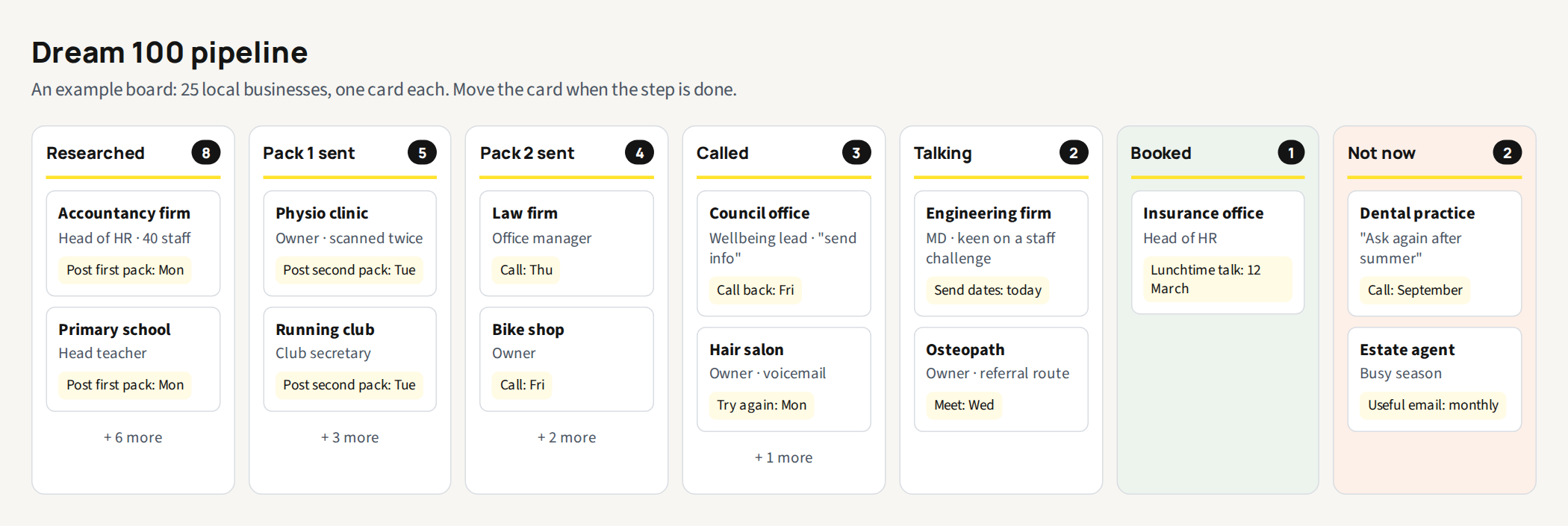
I set this up in HighLevel for gyms and studios, with a pipeline whose stages are: Researched, Pack 1 sent, Pack 2 sent, Called, Talking, Booked, and Not now. Any system with pages, a calendar, a pipeline and automated tasks will do.
Step 3: Follow up until you get a yes or a clear no
This is where most owners stop, and where most of the yeses are. Put every step in your calendar or system before the first pack goes out:
| When | What | Automate |
|---|---|---|
| Week 1 | The first lumpy mail: object, letter and QR code | A card in the pipeline; an alert if they book or reply |
| Week 2 | The second piece, which completes the first | A task to post it |
| Week 3 | A phone call: "I'm the one who sent the flip-flops" | A call task with their details and notes |
| Week 3 onwards | A short email or LinkedIn message with the link | A reminder if there's no reply |
| Every month or two | Something useful: a guide, an invitation, a result | A recurring task until they say yes or no |
What to say when you call
Keep it short and friendly. Something like:
"Hi Sarah, it's Jo from the studio. I'm the one who sent you the flip-flops. Did both of them make it?
The reason I sent them: we run a free 30-minute talk for staff on staying strong and pain-free at a desk. Would a lunchtime in March work for your team?"
Three answers you'll hear, and what to say:
- "Send me some information." "It's all on the page in your pack. Can I call you on Friday, once you've had a look?"
- "We already have a wellbeing provider." "Great. This could sit alongside it, as a one-off for your team."
- "Not right now." "No problem. When would be a better time to talk?" Then set the task for that date.
If the answer is no, ask why, and whether they know anyone else who might be interested. A polite no today is often a yes next year.
Work your way in, too
Brunson's point still stands: don't rely on one channel. While the post is on its way, show up where your Dream 100 already are.
- Follow and comment on their LinkedIn or Facebook posts, with something useful to say.
- Turn up at their events, and support their causes.
- Send people their way before you ask for anything back.
- Buy your way in, if you like: a small ad shown to people who've visited their page, so you stay in view between letters.
By the time your letter arrives, your name should already feel familiar.
Keep it on the right side of the rules
Writing to a named person at a business is still personal data in the UK, so keep it relevant to their role and stop if they ask. The ICO's direct marketing guidance (opens in a new tab) covers post, email and calls.
Follow-up emails and texts have their own rules, and other countries have theirs, so check before you send. This isn't legal advice.
What to measure
- Scans and visits to each business's page.
- Conversations: calls, replies and meetings.
- Yeses: talks booked, partnerships agreed, contracts won.
- Members who came through each partner, and what they pay.
Give it three to six months. In the early weeks, judge yourself on whether every business got its touches on time, not on yeses. Holmes waited four months for his first.
Set a budget per pack, including postage and your time. Then compare it with what one partner is worth: if a partner sends you five members paying $150 a month, that's $750 a month, every month they stay.
Every quarter, review the list. Drop the clear noes, and add businesses that have grown, moved in or changed hands.
What success looks like
Picture six months from now. You run a lunchtime talk for a local employer most months. Two physios send you patients when they finish treatment. And new enquiries start with "Someone at work told me about you."
You're spending less on ads, because other people are introducing you. And you know exactly who you're calling next week.
Or picture the other version: the gym down the road sends the flip-flops first.
Mistakes to avoid
- Too many names, too little follow-up. Twenty-five done properly beats 500 done once.
- An object with no point. It should make your message, not just decorate it.
- Leading with your memberships. Lead with what helps them.
- One letter, then silence. The post opens the door; the call and the follow-up walk through it.
- A generic page. Use their name, their people and their problem.
- Pestering, not helping. Every contact should give them something: an idea, an invitation, a result.
Lumpy mail works for your own lists too: a puzzle piece to former members, or a handwritten card to the best of your old enquiries. See member reactivation for the follow-up.
Questions owners ask
What is the Dream 100?
A strategy from Chet Holmes, later adapted by Russell Brunson: list the people or businesses who matter most to your growth, then focus on getting in front of them repeatedly until they say yes. For a gym or studio, 25 local businesses is plenty.
What is lumpy mail?
Post with an object inside, such as a flip-flop or a stopwatch, that ties in to your message. It gets opened, it gets remembered, and it often reaches the decision maker when a flat letter wouldn't.
How can a gym get corporate clients?
Pick a short list of local employers, offer something that helps their staff, such as a free talk or a challenge, and follow up with lumpy mail, a personal landing page, a phone call and regular useful contact.
Do QR codes work on direct mail?
Yes, when they lead somewhere specific. Give each business its own code and page, so you know who scanned and can follow up while they're interested.
How many times should I follow up with a prospective partner?
Plan for four or five contacts over a few weeks, by post, phone and message, then something useful every month or two until you get a clear yes or no.
Sources
The approach in this article comes from the books and articles below and my own work with gyms and studios, checked in October 2026. The figures in Chet Holmes's story come from his book, as retold in the articles below.
- Chet Holmes: The Ultimate Sales Machine (2007) (opens in a new tab)
- Russell Brunson: Traffic Secrets (2020) (opens in a new tab)
- Julian Mills: The Dream 100 strategy: a modern look at Chet Holmes’ classic client acquisition concept (opens in a new tab)
- Cleverly: What is the Dream 100 strategy and how to use it for B2B outreach (opens in a new tab) (4 June 2026)
- Information Commissioner's Office: Direct marketing guidance (opens in a new tab)

Found this useful? Share it with another owner.
I've spent 25 years in the fitness industry: on the gym floor, running my own boot camps and coaching gym and studio owners since 2012, including leading NPE Fitness's UK and European coaching team. I help independent gyms and studios get and keep more members.