
How to price gym and studio memberships: the Annual Price Review
 By Andrew Wallis · Published 27 October 2026 · 17 minute read
The short answer
Price from your margins first, then check what your market will pay. Never start from what the gym down the road charges.
Reward commitment: the longer someone commits, the better their rate.
Founding-member rates work well if you set the rules before you sell a place.
Then, once a year, run what I call the Annual Price Review: check your margins, your structure and your founder and old rates, then raise prices a little with a personal letter.
Three ways to set a price
There are three ways to set a price, and most owners only use the first.
- Copy the market: look at what others charge and land somewhere near them.
- Work from your margins: add up what it costs to deliver, then add the profit you need to grow.
- Price on value: charge for the result and the experience, not the hour.
Copying the market feels safe. But you copy their costs, their mistakes and their margins too. And you don't know whether they're profitable.
That was value pricing, without the name. What I didn't have yet was the margin side. I learnt that later, as a client of NPE.
The Annual Price Review
Pricing isn't a decision you make once. Costs rise every year, members' needs change, and old offers pile up.
So once a year, about eight weeks before any rise, I take owners through four checks. I call it the Annual Price Review.
The Annual Price Review
Four checks, once a year.
| Step | The question | Tool |
|---|---|---|
| 1. Margins | Does every service leave enough after paying the coach? | Margin calculator |
| 2. Structure | Do your options reward commitment, with a clear choice for most members? | Your price list |
| 3. Old rates | Do founder and legacy rates still pay for themselves? | Founding Member Rate Planner |
| 4. The rise | How much, from when, and how will you tell members? | Price rise calculator and the letter template |
Step 1: check your margins
The lesson NPE taught me was simple: if the margins aren't right, you'll never grow. You'll be busy, but you'll never afford to hire, market or rest.
Your margin is what's left from each session or member after paying for the coaching. That money pays your rent, software, marketing and you.
For a quick check, work out these three things for each service:
- What you earn per session or class. Revenue for that service last month, divided by the sessions you ran.
- What it costs to coach it. Your coach's pay for that session, even if the coach is you.
- What's left, as a share of what the session earns. Aim for 60% or more on private training, and 75% or more on semi-private and group.
The free margin calculator does this for private, semi-private and group training. It also shows what happens to your margin when you add classes.
Most gyms undercharge. Two-Brain Business's State of the Industry 2026 (opens in a new tab) report, built on gym software data from Kilo and Wodify, puts it simply:
"It's usually easier to earn $10 more from every client than to get 10 more clients."
Gyms are starting to listen. The report's median monthly revenue per member rose in a year:
| Type of gym | 2024 | 2025 |
|---|---|---|
| Big group | $150 | $159 |
| Small group | $200 | $240 |
| One-to-one | $254 | $283 |
Two-Brain's founder, Chris Cooper, puts the rise down to owners "charging what they're worth". That lets them pay their staff and run healthy businesses.
Use those as a sense check, not a target. Your margins come first.
Step 2: check your structure
Once you know your margins, decide how people pay. Three formats cover most gyms and studios:
- Memberships: a monthly or weekly fee for a set number of sessions, or unlimited. Steady income, and members who come regularly get results.
- Session packs: 10 or 20 sessions to use within a set time. Useful for people who travel or train irregularly.
- Drop-ins: pay as you go. Your highest price per session, and a way in for new people.
Keep the order clear. A drop-in should cost the most per session, then packs, then memberships. If a pack works out cheaper than a membership, people will choose the pack and train less.
On the Isle of Man, we kept it simple: one session a week, or unlimited. Each camp ran three times a week, so unlimited was the obvious choice for anyone serious.
Offer three options
Give people three clear choices, not one price or ten. Most people avoid the cheapest and the dearest, and choose the middle.
Researchers call it the compromise effect (opens in a new tab). Use it honestly: make the middle option the one that suits most members best.
A higher top option also makes the middle feel like good value, so price the top for the members who want the most coaching.
Reward the longer commitment
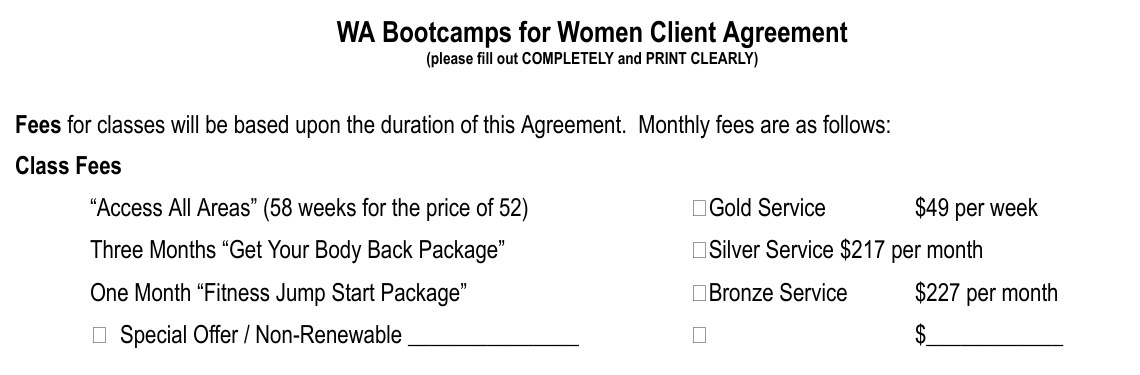
When I moved to Perth, Western Australia, we ran WA Bootcamps for Women. Our client agreement had three levels. The longer someone committed, the lower their rate.
| Level | Commitment | Price |
|---|---|---|
| Bronze: Fitness Jump Start | One month | A$227 a month |
| Silver: Get Your Body Back | Three months | A$217 a month |
| Gold: Access All Areas | A year | A$49 a week, with 58 weeks for the price of 52 |
Three things made it work:
- The names sold the result, not the sessions.
- The year was priced weekly. A$49 a week feels smaller than a monthly fee, even though it adds up to about A$212 a month.
- The bonus beat a discount. Six free weeks rewarded the commitment without cutting the rate.
Four-weekly billing also gives you 13 payments a year instead of 12. Check first that your software handles it, and that you can manage the admin.
Add steps for more coaching
If you offer personal training, online coaching or hybrid programs, build a coaching ladder. Each step gives clearly more coaching, and costs clearly more.
A sports performance clinic I work with starts everyone with an assessment. The figures below are round examples based on its prices:
| Step | What's included | Example price |
|---|---|---|
| Assessment | Everyone starts here, online or in person | $99 online, $199 in person |
| Online membership | A structured program in an app, a video library and a monthly Q&A | $99 a month |
| Online coaching | A program built around them, with regular reviews | $299 a month |
| In person | Coached sessions at the facility | From $99 a month |
| Hybrid | In-person sessions plus online coaching between them | From $399 a month |
There's more on building one in How to build an online training program for your gym or studio.
Corporate rates
On the Isle of Man, I offered companies a corporate rate of £75 a month per person. Three to five companies took it up.
A corporate rate fills quieter sessions and brings in groups who already know each other. Keep it simple:
- A minimum number of people, such as five from the same company.
- One person who organises it on the company's side.
- A rate that still clears your margin. Discount for the volume, not below your costs.
Step 3: check your founder and old rates
This step has two parts: setting up founder rates for a launch, and dealing with old rates you already honour.
Founding-member rates: worth it, with rules
Founding-member rates are a popular way to launch a gym or studio, a new location or a new program. You sell a small number of places at a lower rate before you open.
Gym software companies and consultants describe the same pattern: usually 20 to 50 places, a modest discount, and a rate locked while the membership stays active.
PushPress (opens in a new tab) gives an example of $149 a month for founders against a regular $189.
It works because founders get something real for taking a chance on you. They tend to tell their friends, and you open with a busy room.
Where founder rates go wrong
The industry hasn't turned against founder rates. It has turned against promising a low rate forever, with no rules.
PushPress (opens in a new tab) calls frozen rates a quiet profit killer. Rent, wages and equipment go up every year, but the founder rate doesn't. Most owners only notice years later.
FM Consulting (opens in a new tab) describes gyms where members pay $39, $49, $59 and $69 for exactly the same service. Often the members who train most pay least.
Six rules for a founder offer
- A fixed number of places. When they're gone, they're gone. Never reopen the offer.
- A real closing date, such as the day you open.
- A small gap. 10 to 25% below your standard rate, not half price.
- Continuous or lost. The rate lasts while the membership is continuous. Cancel and return, and you pay the going rate. Allow short pauses for holidays or injury.
- Decide on price rises now. Locked, the same rise as everyone, half the rise, or the founder rate for the first year only.
- Write it down. Put every rule in the terms founders agree to, in plain words.
An outline for a bigger launch
If you're opening premises with several levels of membership, give each level its own founder places. Here's an outline I wrote for a clinic adding a performance gym:
| Level | Founder places | Founder price |
|---|---|---|
| Top tier | 5 | About 20% below standard |
| Middle tier | 15 | About 20 to 25% below standard |
| Entry tier | 20 | About 10 to 20% below standard |
| Regular founder membership | Limited | An early rate, plus priority booking, a bonus consultation and recognition as a founder member |
The small caps at the top make those places feel exclusive. The bonuses give founders more than a lower price.
The plan promised founder pricing "for life". Today I'd write "for as long as your membership is continuous" instead.
The free planner below shows what each rule costs you over five years, and the year a frozen rate would fall below your costs.
With the planner's example figures, a $149 founder rate against $189 costs about $37,000 in discounts over five years.
That's the price of a full room on day one. Decide whether it's worth it before you launch, not five years later.
Old rates you’re still honouring
If you already have members on old rates with no rules, you have four options:
- Keep them if there are only a few and your margin still works. Loyalty has value.
- Move them up at the end of their commitment, with plenty of notice.
- Move them up in steps, such as half the gap this year and the rest next year.
- Offer something new at the new price, such as an extra session or a progress review, so the change comes with more.
Whichever you choose, check it again in each Annual Price Review. A rate that made sense five years ago may cost you money now.
Step 4: set your rise and send the letter
At NPE, we ran a campaign called Raise Your Rates, and I still recommend it to every client. Once a year, raise your prices a little, and tell members personally, in a letter.
A small rise every year is easier for everyone than a big correction every five. Your costs go up every year, so your prices should too.
In Perth, our one-month rate went from A$199 to A$227 a month. Members paid it. From memory, we lost one person, and the feedback was that members appreciated how we went about it.

What to say
Be direct, and don't apologise. Prices go up for every business. Keep the letter about the member, not your costs.
- Say why you're writing in the first line: a modest rise from a set date.
- Acknowledge it in a sentence. You'd rather never raise rates, but costs go up every year.
- Show what it pays for: better-paid coaches who stay, coach education, and equipment and software that improve their sessions.
- Make it personal: their current membership, their new rate, and the date it starts.
- Offer a conversation. If the rise causes real hardship, ask them to reply so you can talk.
- Thank them for their support and trust.
Send it by email, and resend it to anyone who doesn't open it. A short video version works well too, because members see your face and hear your voice.
It also helps to show the rise per session. $10 more a month for 12 sessions is about 83 cents a session.
How much, and how much notice
- A normal yearly rise is small, around 3 to 5%. Most members won't think twice.
- A correction of 10% or more fixes a pricing mistake. Expect more pushback. Be honest that you can't keep giving them the experience they deserve at the current price.
- Give at least 30 days' notice, or longer if your terms say so. Six weeks is better.
- New members pay the new price straight away. Existing members move on the date in their letter.
You'll find a lot of figures online about how many members leave after a price rise. I couldn't find one with a reliable source, so I won't give you one.
What the research does show is that members who come rarely or irregularly are the ones most likely to leave (opens in a new tab).
So check attendance before your letter goes out, and get in touch with anyone who's drifted.
The free price rise calculator shows how many members you could lose and still be better off. It's usually more than you think.
The legal bit
A price rise is only as safe as the contract behind it. This is general information, not legal advice. Check your own terms, and ask a lawyer if you're unsure.
- UK: the CMA's unfair contract terms guidance (opens in a new tab) (updated July 2026) warns that letting a business change prices whenever it likes is likely to be unfair. Say when and how prices can change, with notice and a fair way out.
- UK, from 2027: new subscription rules under the Digital Markets, Competition and Consumers Act are due in January 2027 (opens in a new tab). Expect clearer sign-up information, renewal reminders and easy cancelling.
- Australia: a term letting a business change the price on its own can be an unfair contract term. Consumer Affairs Victoria has a guide for gyms and fitness centres (opens in a new tab).
- US: the FTC's "click to cancel" rule was struck down in July 2025 (opens in a new tab), but federal law and state automatic renewal and health club laws still apply. Check your state's rules.
Founder rules belong in your terms too. A promise in a Facebook post is still a promise.
Mistakes to avoid
- Pricing from the gym down the road. You don't know their costs, or whether they're profitable.
- Discounting to fill a launch. Use a founder offer with rules, or a bonus, instead.
- Packs cheaper than memberships. People pick the pack, come less, and get fewer results.
- Founder rates with no rules. Decide before you sell a place, and write it down.
- Waiting years to raise prices. A big correction is harder than a small yearly rise. Run the Annual Price Review every year.
- Apologising in your letter. Be warm and direct. You're paying for great coaching.
Questions owners ask
How much should a gym or studio charge per month?
Work it out from your margins, not your competitors. As a sense check, Two-Brain Business's 2026 report puts median monthly revenue per member at about $159 for big group training, $240 for small group and $283 for one-to-one.
Are founding-member rates a good idea?
Yes, with rules. Offer a fixed number of places, a small discount and a real closing date. The rate should last only while the membership is continuous, and the rules should be written into your terms.
Should I grandfather old rates when I raise prices?
Only if there are few of them and your margin still works. Otherwise, move members up at the end of their commitment or in steps, with plenty of notice.
What is the Annual Price Review?
A yearly check of your pricing in four steps: your margins, your structure, your founder and old rates, then your price rise and the letter to members. Run it about eight weeks before any rise.
How often should I raise my prices?
Once a year. A small rise of around 3 to 5% is easier for members than a big correction every few years, and it keeps pace with your costs.
How much notice should I give for a price rise?
At least 30 days, or longer if your terms say so. Six weeks is better. Tell members personally, by letter or email, with their new rate and start date.
Will I lose members if I raise my prices?
You may lose a few, usually the ones who come least. Check attendance first, and use the price rise calculator to see how many you could lose and still be better off.
Should I bill weekly or monthly?
Four-weekly billing gives 13 payments a year instead of 12, and smaller, more frequent payments can feel easier. Check your software supports it and that you can manage the admin.
Sources
Every figure in this article comes from the sources below or from my own businesses, checked in October 2026.
- Two-Brain Business: State of the Industry 2026 (6th edition) (opens in a new tab)
- PushPress: Founders club sales plan (opens in a new tab)
- PushPress: Why grandfathered rates quietly kill profitable gyms (opens in a new tab)
- FM Consulting: What if you raised your gym prices 20% and nobody left? (opens in a new tab)
- Managing Sport and Leisure (2024): Who churns from fitness centres? (opens in a new tab)
- Itamar Simonson, Journal of Consumer Research (1989): Choice based on reasons: the case of attraction and compromise effects (opens in a new tab)
- Competition and Markets Authority: Unfair contract terms guidance (CMA37) (opens in a new tab)
- Stephenson Harwood: Subscription reforms brought forward to January 2027 (opens in a new tab)
- Consumer Affairs Victoria: Preventing unfair terms in health and fitness centre membership agreements (opens in a new tab)
- Fenwick: Eighth Circuit vacates FTC’s click-to-cancel rule (opens in a new tab)

Found this useful? Share it with another owner.
I've spent 25 years in the fitness industry: on the gym floor, running my own boot camps and coaching gym and studio owners since 2012, including leading NPE Fitness's UK and European coaching team. I help independent gyms and studios get and keep more members.