

When it comes to Denver Fitness Business Growth, are you seriously still trying to outrank the massive big-box chains for city-wide keywords whilst your actual neighbors don’t even know you exist?
If you’re currently spending your marketing budget trying to rank for “Gyms in [Major City],” you aren’t just fighting an uphill battle in Fitness Business Growth, you’re setting fire to your capital.
I’m writing this whilst enjoying a coffee at Avanti F&B in LoHi, overlooking the Denver skyline and auditing one of the most competitive fitness pockets I’ve seen in months.
From a Growth Architect’s perspective, this area is a live case study in Denver Fitness Business Growth—dense competition, premium positioning, and a brutal reminder that generic SEO is dead.
Here is what most studio owners are doing wrong:
- Bidding on broad keywords with $10-$12 per click costs—this is where most studios bleed money through poor targeting.
- Focusing on “National Authority” when they only need 50 more members.
- Neglecting the very “near me” searches that happen 200 yards from their front door.
The result? Your website is a digital ghost town. You have a world-class facility, elite-level coaching, and a community that changes lives, but on Google, you are completely invisible.
Why Your “City-Wide” Strategy Is a Losing Battle
Stop chasing city-wide glory, start dominating your 3-mile radius.
When I look at the search landscape here in Denver, the competition for “Denver Gym” is a suicide mission. You’re competing against Orangetheory, Lifetime Fitness, and Everyman’s CrossFit. You will not win that war on a boutique budget.
However, when I narrow the focus to the 80211 zip code, the game changes.
The “Local Authority” Pivot is about shifting your focus from the macro to the micro. Most fitness business owners think bigger is better. They’re wrong. In the world of Fitness Business Growth, hyper-local relevance is the only currency that matters.
If you are a studio in LoHi, you don’t need to rank in Aurora or Boulder. You need to own the search results for the person walking their dog past the LoHi Athletic Club or grabbing a post-flow smoothie near Canopy Yoga.
Here’s the problem: I’ve spent the last few days walking these streets, and whilst the physical facilities are stunning, Traverse Fitness on W 38th Ave is still a strong example of a High-Performance Facility with sharp positioning and a slick brand.
But even best-in-class sites can have under-the-hood issues. Things like repeating the main title twice, cramming in too many search phrases, or creating confusing page signals can quietly hurt rankings.
That’s the real contrast. A site can look polished on the surface and still have hidden issues underneath. Many smaller boutiques nearby still have the “vehicle” (the gym), but they lack the Growth Engine OS to drive people into it, which is why their digital visibility falls apart.

The “Missing System”: Why Great Facilities Stay Empty in Fitness Business Growth
It’s not your coaching that’s failing, it’s your visibility system.
Most owners I meet are “Hustlers.” They think that if they just work harder, grind more, and post one more shirtless reel on Instagram, the leads will magically appear. That is a lie.
The “Missing System” in 90% of the independent gyms I’ve audited this week is a predictable Local SEO strategy. They treat Google as an afterthought, yet 80% of high-intent “buy now” traffic starts with a local search.
If you aren’t in the “Local Map Pack” (the top 3 results on Google Maps), you don’t exist to the “near me” crowd.
Your local SEO isn’t just a technical “to-do” list; it is a digital business card. When I drop by a facility to check out a session, the first thing I do is Google them. If I see a half-finished Google Business Profile, zero recent reviews, and a website that looks like it was built in 2012—or a site with messy basics like duplicated main titles or awkward sub-headings—I’m out.
Here’s what’s happening instead: The studios that are winning are using their digital presence to build rapport before the prospect even walks through the door. They use the Growth Engine OS to ensure that every touchpoint, from the search result to the landing page, screams “Expertise.”
Step 1: Claim Your Neighbourhood, Not Your City for Fitness Business Growth
Your goal is to become the “Mayor” of your specific zip code.
How do you do it? You stop being generic. If you’re a PT in London, stop trying to rank for “London Personal Trainer.” Start ranking for “Personal Trainer in Shoreditch” or “Strength Coach near Old Street Station.”
In Denver, that means optimizing for “LoHi Fitness” or “Personal Training 80211.” This isn’t just about keywords; it’s about Neighbourhood Dominance.
The Action Plan:
- Google Business Profile (GBP) Overhaul: This is your most important asset. Post 3x a week. Upload high-res photos of your facility. Respond to every single review, even the bad ones.
- Hyper-Local Landing Pages: Create a page on your site specifically for your neighborhood. Mention local landmarks. Mention the coffee shop next door. Tell Google exactly where you are located.
- Local Backlinks: Get listed in local neighborhood directories. Sponsor a local 5k run. Partner with the juice bar around the corner and link to each other.
Stop ignoring the low-hanging fruit.
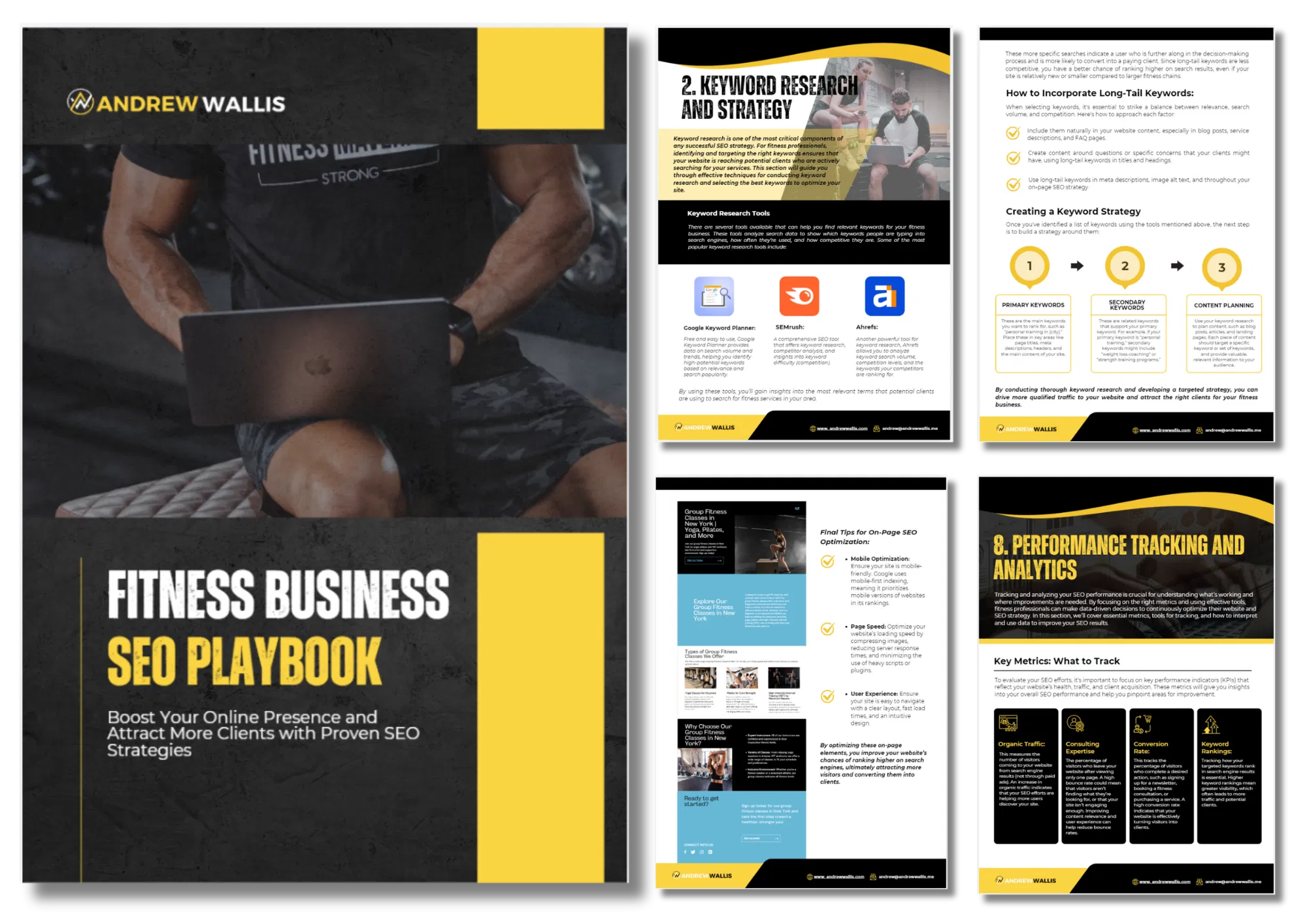
*If you want the full blueprint on how to execute this, grab my Fitness Business SEO Playbook. It’s a solid secondary resource if you want to sharpen the basics whilst you build the bigger system and support stronger Denver Fitness Business Growth.*
The Sales Enablement Angle: SEO is Your 24/7 Closer
Stop thinking of SEO as “tech” and start thinking of it as “sales.”
Most people think SEO is about “traffic.” It’s not. It’s about Lead Flow.
When someone searches for “Yoga near me” and finds Canopy Yoga, the SEO has already done 50% of the sales work. It has provided the location, the social proof (reviews), and the authority. By the time that person clicks “Book Class,” the “sale” is almost a formality.
Local SEO acts as a digital business card for your walk-ins. When I walk into a gym or studio in LoHi and the owner is too busy to talk, I’m going to search for them later. If their SEO is on point, they stay top-of-mind. If it isn’t, I’ll find their competitor who is ranking.
Your business is either the obvious choice or the invisible one. There is no middle ground.
The Global Lesson: From Denver to Your Front Door
Whether you are in LoHi, Leeds, or Lisbon, the “Growth Engine” remains the same.
You might be thinking, “Andrew, I’m not in Denver, does this apply to me?”
Absolutely.
The principles of Fitness Business Growth are universal. Whether I’m looking at the competitive landscape of Denver or a small town in the UK, the bottleneck is always the same: A lack of predictable systems.
- Traffic (Local SEO)
- Conversion (Your Offer)
- Retention (Your System)
If you are stuck at $15k–$25k per month, it’s because you are relying on “Hustle” instead of “Systems.” At this level, hustle is no longer about squeezing in more sessions. It’s about the failure of your local lead-flow systems to keep the facility at capacity. You are manual-laboring your way to growth rather than building an engine that does the work for you.

What Is Your Visibility Gap?
It’s time to stop guessing and start diagnosing the real problem.
Most studio owners think they have a “sales problem” or a “marketing problem.” Usually, they have a system problem.
Before you spend another penny on Meta ads or another hour on TikTok, you need to know where your engine is leaking. You need to know if you are actually visible to your target market.
Are you the “Local Authority,” or are you just another gym taking up space?
Check out the Growth Engine Scorecard. It takes less than 3 minutes and will give you a brutal, honest look at why your business isn’t scaling the way you want it to.
Don’t stay invisible. Build the engine. Own the neighborhood.
Meet Me in Denver: Let’s Build Your Growth Engine
If you’re in Denver and your business feels invisible, why not fix that whilst I’m actually here?
I’m currently in Denver for the next 6 weeks, and I’m keen to connect with local gym owners, studio owners, and fitness operators who know they’ve got a strong product—but need a better engine behind it.
If that’s you, here’s the invitation:
- Let’s grab a coffee at Little Owl or a quick lunch at Avanti and talk shop whilst I’m in town.
- I’m opening a few spots for the Skool Growth Engine OS beta launch specifically for Denver locals whilst I’m on the ground here.
- I’m also planning a Denver Fitness Leaders Dinner later in the trip — so if you’d like an invite, reach out and I’ll keep you in the loop.
- This is for owners who are done being invisible and want to turn their business into a high-performance engine with better lead flow, stronger conversion, and less owner-dependence.
This isn’t about piling on more random tactics.
It’s about installing the right system.
Depending on your stage, that might mean fixing your local visibility, tightening your offer, or building the follow-up that stops leads going cold. One engine → multiple vehicles.
If you’re in Denver and want to connect, start with the Growth Engine Scorecard so we can see where your bottlenecks really are before we talk—and if you’re serious about building a better system, ask me about the Growth Engine OS beta. That’s how you stop guessing and start building real Denver Fitness Business Growth.
FAQ: Local SEO for Fitness Businesses
What is Local SEO?
Local SEO is the process of improving your online presence so more local people find you when they search. For a gym, this means showing up in the “Map Pack” when someone looks for fitness services in your specific neighborhood or zip code.
Why is my gym not showing up on Google Maps?
This is usually due to inconsistent business details like your name, address, and phone number, a weak Google Business Profile, or a lack of local relevance. It can also come from under-the-hood website issues—like repeating your main title, stuffing too many search terms onto a page, or sending mixed signals about what the page is about. Google needs to trust that your business is a legitimate, active part of the community before it will rank you.
How long does Local SEO take to work?
Whilst deeper website fixes can take months, local improvements like cleaning up your Google Business Profile can often show movement in as little as 30 days. It is one of the fastest ways to increase high-intent lead flow without paying for ads.
Do I need a blog for Local SEO?
Yes. Creating “Boots on the ground” content: like a guide to the best running trails in your neighborhood: signals to Google that you are a local authority. It’s about building a “bridge” between your business and the local community.
About Andrew Wallis
Andrew Wallis is a business growth consultant and the “Growth Architect” for fitness professionals. After years of building successful businesses, he now helps personal trainers, studio owners, and franchisees install the Growth Engine OS: a proven system to attract high-quality clients and scale without the burnout. Whether you’re just starting or stuck at a plateau, Andrew provides the roadmap to turn your passion into predictable, profitable Denver Fitness Business Growth and beyond.

Ready to stop the hustle? Take the Scorecard now.
Slug: denver-fitness-business-growth-local-seo
SEO Title: Denver Fitness Business Growth: Why Local SEO is Your Most Underused Asset
Meta Description: Discover the secrets to Denver Fitness Business Growth through local SEO. Learn how to dominate your neighborhood and fill your studio without burning out on hustle.

