

Are you still the most important person in your gym—or have you just built yourself a nicer cage? Achieving sustainable fitness business growth isn’t just about working harder; it’s about moving from being the technician who does the work to the owner who builds the machine.
If you vanished for three weeks: no phone, no email, no “just checking in”: would your business thrive, or would it wobble like a cheap squat rack?
If that question makes your stomach churn, you don’t own a business. You own a high-stress, low-freedom job where you’re the busiest and most overworked employee.
Most gym owners started because they were world-class coaches. You loved the floor. You loved the transformation. But now? That coaching expertise has become the single biggest bottleneck in your company.
Here’s what’s likely happening right now:
- You’re still the one closing every high-ticket sale.
- You’re the one stepping in when a trainer calls in sick.
- You’re the one answering every DM and fixing every billing error.
- You’re the one everyone looks to for permission before they breathe.
Here is the brutal truth: You cannot hustle your way to a multi-location brand or a £50k/month studio if every single decision requires your manual approval.
In this post, I’m going to show you exactly how to stop being the Technician and start becoming the Growth Architect your business actually needs.
1. The ‘Technician’ Trap: Why Your Passion is Killing Your Profit
Most fitness professionals fall into the Technician Trap because they mistake “doing the work” for “building the business.”
This challenge is a classic case of the conflict between The Technician, The Manager, and The Entrepreneur.
When you’re a technician, you focus on the input. You think that if you just coach better, work harder, and stay longer, the business will naturally grow. It won’t.
Hustle is not a strategy: it’s a recipe for burnout.
At the start, your energy was the engine. You were the one driving leads, the one converting them, and the one delivering the results. But as you scale past the £10k-£15k mark, that “personal touch” starts to scale you right out of a life.
You’ve reached what we call the Owner Dependency stage of the Growth Engine OS. This is the plateau where you’re too big to do everything yourself, but too small (or too unorganized) to have a team that functions without you.
STOP doing everything yourself: START building systems that do it for you.
2. Level 4 of Fitness Business Growth: The Owner Dependency Signal
In my consultancy, we categorize Fitness Business Growth into levels. Level 4 is the danger zone. This is usually where revenue sits between £20k and £50k per month.
On paper, you’re successful. In reality, you’re knackered.
This is the stage where the business looks solid from the outside—but inside, Owner Dependency is quietly running the show. You’re making decent money, yet everything still seems to need your face, your voice, or your rescue mission.
The signs of Owner Dependency are everywhere:
- Lead flow is inconsistent because you only market when you have “time.”
- Conversion drops the moment you delegate sales to a staff member.
- Retention fluctuates because your trainers don’t deliver the “magic” you do.
- Operations stall whenever you step off the floor for more than five minutes.
Here’s the problem: You’ve built a business around your personality, not a process. Great for your ego. Terrible for scale. If you want to move to Level 5 and beyond, you have to shift your identity.
You need to move from being the Engine (the thing that makes it go) to being the Growth Architect (the person who designs and maintains the engine).
And if you’re already in that £20k-£50k/month Level 4 signal, you don’t need another random tactic from Instagram. You need strategic redesign. That’s exactly where the IGNITE Strategy Intensive fits—it helps you diagnose the bottlenecks, remove owner-dependence, and install the right priorities before your growth turns into chaos.
If you’re feeling this pressure, start with clarity. Check out our Growth Engine Scorecard to see exactly how dependent your business is on your manual labor—then, depending on your stage, use the IGNITE Strategy Intensive to map the next move.
3. The Three Pillars of the Shift: From Floor to Boardroom
To make this transition, you don’t need “more help.” You need more structure. You need to install three specific pillars that allow the business to breathe without you.
Pillar 1: Standardized Delivery (SOPs)
If your clients only get results when you train them, your product is a failure. Harsh, but true.
This is why SOPs for gyms matter so much. Not the fluffy kind that sit in a Google Drive graveyard. The useful kind your team can actually follow on a busy Tuesday at 6pm.
You need Standard Operating Procedures (SOPs) for everything. I’m talking about:
- The Greeting within 30 seconds: How a client is welcomed within 30 seconds of walking in—eye contact, name used, energy set, no awkward wandering around reception like they’ve entered the wrong building.
- The Session: The exact flow of a 45-minute workout.
- The 24-hour miss-session follow-up: What happens within 24 hours after a member misses a session—message sent, concern shown, rebooking prompt made, and accountability re-established before they drift.
When you have SOPs, you aren’t managing people; you’re managing the system. This ensures the product is consistent whether you’re on the floor or on a beach in Spain.
Pro-Tip: The First SOP to Write Today
If you do nothing else today, write the 24-hour miss-session follow-up SOP first.
Why? Because missed sessions are rarely about one missed workout. They’re the first crack in retention. Ignore them and churn creeps in. Catch them quickly and you protect revenue, results, and relationship.
Start simple:
- Trigger: Member misses a booked session.
- Action: Send a personal message within 24 hours.
- Goal: Rebook immediately and restart momentum.
- Owner: Assign responsibility to one role, not “whoever notices.”
That one SOP alone can improve retention faster than another motivational reel on Instagram. And yes, that was a dig.
If you want to see where these operational gaps are costing you growth, check your business with the Growth Engine Scorecard before they turn into bigger leaks.
Pillar 2: Team Systems & Leadership
Most gym owners “hire” people but they don’t actually lead them. They micromanage.
Micromanagement is just a lack of systems.
Instead of watching over their shoulder, give them a framework to succeed. This starts with a rock-solid onboarding process. You shouldn’t be teaching a new trainer how to use your CRM by hand every time. You should have a training module ready to go.
If you’re struggling with content or how to present these systems to your team, check out our guide on moving from internet rubbish to content gold to help structure your internal training.
Pillar 3: KPI Dashboards
You cannot manage what you do not measure.
The Technician manages by “feel.” They feel like it was a good week because the energy in the gym was high. The Growth Architect manages by the numbers.
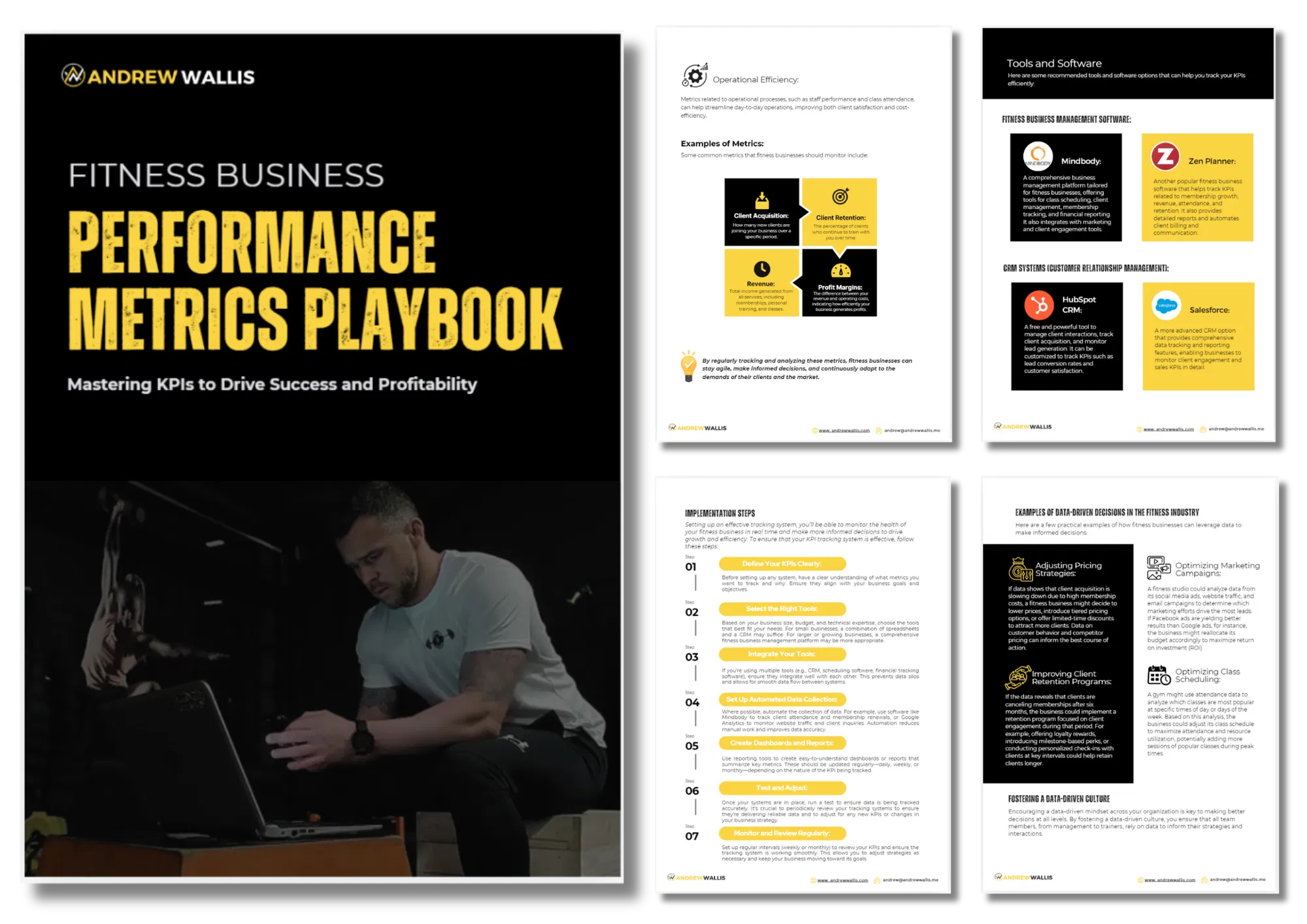
Inside the Growth Engine OS, I call these the Architect’s metrics—because they tell you whether the business is actually getting stronger, or just getting louder.
You need a KPI Dashboard that tracks:
- Lifetime Value (LTV): How much a member is worth over their full time with you.
- Cost Per Lead (CPL): What it costs to generate a lead through your marketing.
- Churn: How many members are leaving—and how quickly the bucket is leaking.
- Sales Conversion Rate: How well your team turns interest into paid memberships.
When you have these numbers, you don’t need to be in the gym to know if it’s working. You just need to look at the data. That’s how you reduce Owner Dependency and make smarter decisions without relying on gut feel and wishful thinking.
4. Why Hustle Stops Working for Fitness Business Growth
At a certain point, more effort yields diminishing returns.
If you’re already working 60 hours a week, you literally cannot work “harder” to double your revenue. There aren’t enough hours in the day. This is where most Fitness Business Growth plans fall apart—they’re built on effort, not infrastructure.
Instead, you must leverage.
The transition from Technician to Owner is a transition from labor leverage to systems leverage.
- Old Way: You run a Facebook ad, you call the lead, you do the intro, you coach the session.
- New Way: You install an automated lead-nurture sequence, your admin books the intro, and your head coach delivers the session.
That is the point of the Growth Engine OS: one engine, multiple vehicles. Depending on your stage, the same system supports lead flow, conversion, delivery, and scale without forcing you to be the human glue holding everything together.
You are the architect. You design the blueprint, you hire the contractors, and you ensure the build is on schedule. You do not pick up the hammer.
If you’re not sure where the bottleneck actually is, start with the Growth Engine Scorecard. If you’re already at Level 4 and need to redesign the machine, the IGNITE Strategy Intensive is the next obvious move.
5. Becoming a Growth Architect
Moving from Technician to Owner isn’t just a change in your daily tasks: it’s a complete identity shift.
You have to be okay with not being the “star” of the show. You have to be okay with your staff being the ones clients rave about. In fact, that should be your goal.
The Growth Architect’s job is to solve the puzzle of scale.
If you’re stuck at the £5k-£10k mark, you’re likely still fighting for leads. If you’re at the £20k-£50k/month Level 4 signal, you’re fighting for time, control, and consistency. Different symptoms. Same engine problem.
The solution is the same: The Growth Engine OS.
Depending on your stage, that might mean fixing lead generation, tightening SOPs for gyms, improving conversion, or removing Owner Dependency from delivery. And if you’re already in that Level 4 band, the fastest route is usually not another tactic—it’s strategic simplification through the IGNITE Strategy Intensive.
Are You Ready to Step Off the Floor?
The journey from coach to CEO is the hardest one you’ll ever take. It requires you to let go of the very things that made you successful in the first place: your “personal touch” and your “hustle.”
But on the other side of that transition is true freedom. A business that pays you whether you show up or not. A brand that exists beyond your physical presence.
Stop being the engine. Start being the architect.
Take the first step today.
Grab our Growth Engine Scorecard and find out exactly where your business is leaking profit and where you are still the biggest bottleneck. It takes 2 minutes and will give you the roadmap you need to move from Level 4 to Level 5.
If the score shows you’re already in the £20k-£50k/month Level 4 zone, don’t just “work harder” and hope for the best. Book the IGNITE Strategy Intensive and fix the architecture before growth becomes a very expensive mess.
FAQ: Transitioning Your Fitness Business
What is the ‘Technician Trap’ in a fitness business?
The Technician Trap is a state where a gym owner remains focused on the “doing” of the work (coaching, sales, cleaning) rather than the “building” of the business. It leads to a growth ceiling because the business can only scale as far as the owner’s personal time allows.
What is ‘Owner Dependency’?
Owner Dependency is a business stage where the operations, sales, and service delivery rely entirely on the owner’s presence or manual approval. Without the owner, the business cannot function or maintain quality, preventing any real scalability.
What are SOPs for gyms?
SOPs for gyms are documented, step-by-step instructions that define how tasks are completed across service, operations, and follow-up. SOPs for gyms matter because they create consistency, reduce mistakes, and make it easier for staff to deliver a reliable client experience without constant supervision from the owner.
What is the Growth Engine OS?
The Growth Engine OS is Andrew Wallis Consultancy’s operating system for Fitness Business Growth. It is a simple, proven framework designed to reduce Owner Dependency by improving lead flow, conversion, delivery, and retention through better systems.
Why do KPI Dashboards help gym owners?
KPI Dashboards help gym owners because they replace guesswork with evidence. The key Architect’s metrics are LTV, CPL, and Churn—because these numbers show whether your marketing is efficient, your retention is healthy, and your business can grow without the owner needing to manually inspect everything.
What is Level 4 in the Growth Engine OS?
Level 4 in the Growth Engine OS is the stage where many fitness businesses generate around £20k-£50k per month but still struggle with owner-dependence, inconsistent execution, and bottlenecks in delivery. It often looks successful from the outside whilst feeling chaotic behind the scenes.
How do I move from a Level 4 to a Level 5 business?
Moving to Level 5 requires shifting from “Manual Everything” to “Systems Everywhere.” This involves hiring the right team, training them through SOPs, using KPI dashboards, and removing key-person dependency from marketing, sales, and service delivery. For many Level 4 businesses, the fastest next step is to start with the Growth Engine Scorecard and then use the IGNITE Strategy Intensive to plan the transition properly.
Category: Pathway 3: Studio & Gym Owners
About Andrew Wallis Consultancy
Andrew Wallis is the Growth Architect for fitness businesses. We help personal trainers, studio owners, and gym entrepreneurs move from being overworked “technicians” to becoming the owners of high-profit, self-sustaining growth engines. Through our Growth Engine OS, we provide the frameworks, systems, and KPIs needed to scale without burnout. Depending on your stage, that can mean better lead flow, stronger conversion, tighter SOPs for gyms, and less Owner Dependency across the business.
Ready to scale? Start here with the Growth Engine Scorecard.
Already at Level 4? Explore the IGNITE Strategy Intensive.

