

If you want to stop burning money on Meta ads and finally dominate your area, you need to master local seo for gyms. Most fitness studio owners are still wondering why new members never reply on WhatsApp, whilst their savvy competitors are quietly winning the local search game.
You’re probably still doing this:
- Boosting posts and hoping “nearby” people see them.
- Running the same 6-week challenge ads as everyone else.
- Relying on Instagram like it’s your whole marketing plan.
- Ignoring Google Maps because it feels “too technical”.
Here’s what’s happening instead:
- Costs keep rising whilst results keep dropping.
- Leads go cold fast and you chase people all day.
- You stop paying and the enquiries disappear overnight.
Now fix the real problem.
Local SEO for gyms is simple: it’s the work you do to help Google and Google Maps show your gym when someone nearby searches “gym near me”, “PT studio in [town]”, or “strength training for beginners”.
It’s about ranking in the top 3 map results, getting calls, website clicks, and direction requests—without paying per click.
Here is the problem: you’re building your business on rented land.
While you chase the next “viral” ad hack, your competitors are quietly winning the local map pack. They aren’t paying for every click. They’re building owned digital real estate.
In 2026, local SEO for gyms isn’t “nice to have”. It’s survival.
STOP feeding the Meta money pit—START building equity in your Google presence.
Check out the Growth Scorecard to see if your local lead flow is stable—or hanging by a thread.
Table of Contents
- Why Meta Ads Are Killing Your Margins (And Why You Must Pivot)
- Your Website: The Only Digital Real Estate You Actually Own
- Hitting Google’s E-E-A-T Guidelines (And Proving Real “Experience”)
- From SEO to AEO: Winning the AI Search Game
- Google Business Profile: Your Local Dominance Engine
- The “Owned Real Estate” Content Strategy (The Stuff That Actually Ranks)
- The Path to Local Domination (Your 14-Day Map Pack Sprint)
- FAQ (For Top 3 Rankings + AEO)
Why Meta Ads Are Killing Your Margins (And Why You Must Pivot)
Let’s be honest. Meta ads are becoming unaffordable for a lot of gym owners.
The market is completely saturated. Everyone’s pushing the same “6-week challenge” or “21 days for £21”. So the auction gets more expensive—and the leads get worse.
Here’s what’s happening instead: people have ad blindness. They scroll past your sponsored posts because they look like every other generic gym ad.
You are probably experiencing:
- Rising Cost Per Lead (CPL) that kills your margins.
- Low-quality leads who want “cheap” not “help”.
- Endless content pressure to keep ads fresh.
- Zero long-term value—stop paying and leads stop.
That is a dangerous way to run a business.
Here’s the pivot: rank where intent already exists.
When someone searches:
- “gym near me”
- “best gym in [area]”
- “small group PT [town]”
- “hyrox training [city]”
…they’re not “browsing”. They’re choosing.
That’s why local SEO beats ads in the long game.
What doesn’t work vs. what does work:
| What most gyms do (weak) | What top 3 gyms do (wins) |
|---|---|
| Chase strangers with ads | Get found on Maps |
| Sell discounts to everyone | Position for a clear niche |
| Reply manually to every enquiry | Automate follow-up and booking |
| Post randomly on Instagram | Publish local proof on Google and your site |
If you want this to be predictable, you need a system—not vibes.
Grab the Growth Scorecard and you’ll see exactly what’s missing in your local lead flow.
Your Website: The Only Digital Real Estate You Actually Own
Most gym owners treat their website like a digital brochure. It sits there collecting dust whilst you post on Instagram.
This is a massive mistake.
Your website is owned digital real estate. It’s the only place online where you control the rules. When you build fitness studio marketing around your site, you create an asset that grows in value over time.
In 2026, your website has to satisfy two audiences:
- Humans looking for the right gym.
- Google + AI tools (LLMs) deciding who to recommend.
No high-performing website = no front door.

Hitting Google’s E-E-A-T Guidelines (And Proving Real “Experience”)
Google doesn’t just look for keywords now. It looks for proof. That’s E-E-A-T: Experience, Expertise, Authoritativeness, and Trustworthiness.
If your website feels like a ghost town, Google won’t risk sending you traffic.
To rank top 3 for local SEO for gyms, you must show you’re real—and you get real results.
Here’s how a gym can show Experience (specific examples):
- Show your real facility with a short “walk-through” video—front door, reception, training floor, changing rooms.
- Show real coaching—a 20-second clip of you correcting a squat, scaling a workout, or coaching a beginner.
- Show your timetable in action—photos of a Monday evening class, not a staged shoot.
- Show your onboarding—a simple 3-step “Start Here” process (tour → assessment → first session).
- Show your safety and standards—cleaning checklist, coach-to-member ratios, induction rules.
- Show proof of attendance—screenshots of class bookings (blur names), busy peak times, community events.
- Show local stories—“Sarah from Ramsey trained twice a week for 12 weeks…” with before/after context.
Then back it up with the rest of E-E-A-T:
- Expertise: Write simple, clear pages for common problems (fat loss, back pain, menopause training, Hyrox prep).
- Authoritativeness: Get local mentions—charity events, schools, sports clubs, local podcasts.
- Trustworthiness: Display your Google reviews, pricing clarity, coach bios, and contact details.
If you don’t prove E-E-A-T, you won’t rank. Google is risk-avoidant.
Want the checklist I use with studio owners? Start with the Growth Scorecard.
From SEO to AEO: Winning the AI Search Game
You’ve heard of SEO. But have you heard of AEO (Answer Engine Optimization)?
In 2026, people aren’t just typing “gym near me” into a search bar. They are asking their AI assistants: Perplexity, ChatGPT, or Gemini: “What is the best gym in Manchester for a 40-year-old with back pain?”
If your website doesn’t provide the direct answer to that question, the AI will recommend your competitor instead.
To win at AEO, you must:
- Create “Question and Answer” content. Use FAQs on your service pages.
- Use structured data (Schema markup). This helps AI understand exactly what you offer, your opening hours, and your location.
- Be specific. Stop trying to be the “best gym for everyone.” Be the best gym for a specific person with a specific problem.
This is how you get featured in AI Insights and LLM search summaries. This is how you get high-intent leads who are already convinced you are the expert before they even click your link.
Want to know if your brand is AI-ready? Grab your Growth Scorecard results now.
Google Business Profile: Your Local Dominance Engine
If you haven’t touched your Google Business Profile (GBP) in months, you’re leaving money on the table.
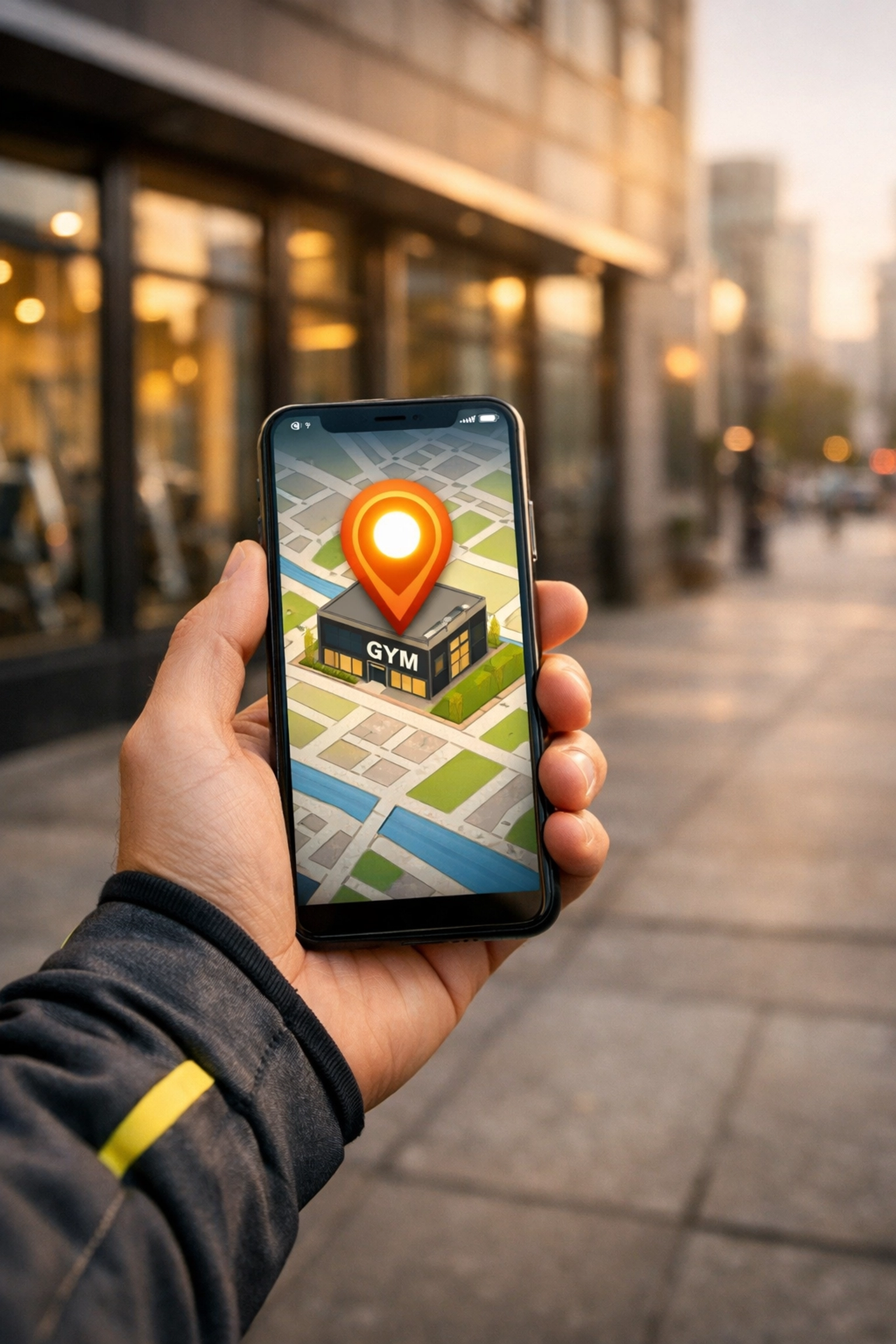
For a local gym, GBP is often more important than your website at the start. It’s what shows in the Local Pack (the top 3 on Google Maps).
If you aren’t top 3, you’re basically invisible.
Here’s the tactical plan.
Step 1: Nail your NAP (and keep it consistent).
Your Name, Address, and Phone number must be identical everywhere online—website, socials, directories. Even small differences can confuse Google. If you want Google’s own guidance, start here: Google’s Business Profile Help: https://support.google.com/business/
Step 2: Pick the right primary category (this is huge).
Don’t guess. Choose the closest match (e.g., Gym, Personal trainer, Fitness centre, Pilates studio) and then add a few supporting categories. This helps Google understand what you actually are.
Step 3: Fix your “money” sections.
- Services: add your main offers in plain English (small group PT, 1-to-1 PT, classes, Hyrox prep).
- Description: say who you help, where you are, and what makes you different.
- Photos: upload real photos weekly—coaches, floor, kit, classes, community.
- Products (optional): list “Start Here” options like a free tour or 7-day trial.
Step 4: Get reviews on purpose (not “when you remember”).
Set up a simple WhatsApp request that triggers after week one:
“Hey [Name]—quick one. How was your first week at [Gym]? If you enjoyed it, can you drop a Google review? It helps local people find us.”
More reviews = more trust = higher rankings.
Step 5: Post weekly updates (yes, it matters).
Treat GBP like a mini feed:
- New member wins
- Coach tips
- Timetable updates
- Local events
- Links to your blog
If you want to know what to fix first, run the Growth Scorecard. It’ll show the fastest wins.
The “Owned Real Estate” Content Strategy (The Stuff That Actually Ranks)
So how do you create content that satisfies humans, Google, and AI?
Stop writing “top 5 tips for abs”. It’s fluff. It won’t rank. And it won’t convert.
Instead, build “Hyper-Local Authority” content. The goal is simple: when someone in your area asks a question, your gym is the answer.
Use these 4 content types (rotate them weekly):
1) Local intent pages (money pages).
These are pages that bring leads, not likes:
- “Small Group PT in [Town]”
- “Hyrox Training in [City]”
- “Strength Training for Beginners in [Area]”
Keep each page simple: - Who it’s for
- What happens in week one
- Price range or starting price
- Timetable
- How to book (button + WhatsApp option)
2) Local proof posts (story pages).
Google loves proof because people trust proof.
- “How James from [Town] trained around a bad back”
- “From zero fitness to 3 sessions a week—12-week story”
Keep it honest. Add photos, sessions per week, what you changed, and what results happened.
3) Local lifestyle content (link magnets).
These build relevance and local links:
- “Best running routes in [Town]”
- “Where to eat healthier in [City] after training”
- “Beginner-friendly gyms: what to look for in [Area]”
4) Problem-solver FAQs (AEO bait).
Write short Q&A sections inside posts and pages:
- “How much does a gym cost in [Town]?”
- “Is small group PT worth it?”
- “Can I train with knee pain?”
Here’s what’s happening instead when you do this: you start ranking for loads of long-tail searches—the ones with high intent and low competition.
Want my exact content plan for a “Perfect Repeatable Week”? Use the Growth Scorecard first—then you’ll know which pages to build.
The Path to Local Domination (Your 14-Day Map Pack Sprint)
The fitness industry is changing. The “pay-to-play” Meta model is no longer sustainable.
So let’s make this practical.
If you want top 3 rankings, you need focused action—not random marketing.
Do this 14-day sprint:
Day 1–2: Fix the basics.
- One exact NAP everywhere (website footer, contact page, socials).
- One clear offer you want to rank for (e.g., small group PT).
- One main location phrase (town/area you actually serve).
Day 3–5: Build one “money page”.
- Title like: Small Group Personal Training in [Town]
- Add prices or starting from
- Add timetable
- Add FAQs
- Add book now + WhatsApp button
Day 6–9: Upgrade Google Business Profile.
- Add 10 new real photos
- Add services (with simple wording)
- Post 3 updates
- Get 5 reviews (ask via WhatsApp)
Day 10–14: Publish proof.
- Write one member story
- Write one local guide (routes, parking, beginner tips)
- Add those links into your GBP posts
Do this and you stop guessing. You start stacking proof.
Ready to see where your gym is weak right now? Get the Growth Scorecard and you’ll see the exact gaps to fix.
FAQ:
What is local SEO for gyms?
Local SEO for gyms is the process of helping your gym show up in Google Maps and local search results when people nearby search for a gym, classes, or personal training.
How do I rank my gym in the top 3 on Google Maps?
Optimise your Google Business Profile, keep NAP consistent, collect steady reviews, post updates weekly, and match your website pages to what people search in your area.
What should I put on my Google Business Profile to get more members?
Pick the right category, add services, upload real photos weekly, answer Q&As, post updates, and make it easy to call, message, or book.
How many reviews do I need to rank a gym locally?
There’s no magic number. You need a steady flow of recent reviews, with keywords people use (like “small group PT” and your town), plus replies from your team.
Does my gym website matter if I have Google Business Profile?
Yes. Your website helps you rank for more searches and proves E-E-A-T. GBP gets you seen; your site helps you win the click and the booking.
What is AEO and why does it matter for gyms?
AEO (Answer Engine Optimisation) means writing clear answers that AI tools and Google can quote. It helps you get recommended in AI summaries and featured snippets.
How long does local SEO take for a gym?
Expect early movement in 2–6 weeks, and stronger results in 3–6 months—if you post proof and collect reviews every week.
What’s the fastest local SEO win for a gym owner?
Ask for reviews via WhatsApp after week one, add real photos to GBP weekly, and build one strong “money page” targeting your main service + town.
About Andrew Wallis
Andrew Wallis is the founder of Andrew Wallis Consultancy. With over 25 years of experience in fitness and business, he helps personal trainers, studio owners, and franchises grow with simple marketing systems that actually work—without relying on ads or burning out.

