

If you’re wondering whether scaling a fitness business simply requires more hustle, let’s clear that up right now: it doesn’t. In 2026, growth isn’t about working harder; it’s about building a better engine that moves you away from the ‘content hamster wheel’ and into predictable revenue
If you’re currently stuck on the content hamster wheel, praying for referrals, or drowning in admin while your bank account barely budges, you aren’t alone.
Most fitness professionals are excellent at coaching but terrible at architecture. They build a “job” for themselves, not a business.
Here is what your “strategy” probably looks like right now:
Posting random reels hoping to “go viral.”- ~~Discounting your rates to “compete” with the local big-box gym.~
- ~~Handling every single lead, booking, and invoice personally.~
- ~~Relying on “word of mouth” as your only marketing strategy.~
The result? Inconsistent income, chronic burnout, and a ceiling you can’t seem to smash through.
You’re trading maximum effort for minimum systems, and it’s killing your growth.
It’s time to stop thinking like a trainer and start thinking like a Growth Architect.
At Andrew Wallis Consultancy, we don’t believe in “magic pills.” We believe in the Growth Engine.
Whether you are a solo PT looking for your first £5k month or a multi-location franchise owner eyeing a seven-figure exit, the framework remains exactly the same. One engine, multiple vehicles.
The Growth Engine: Why Your Vehicle Doesn’t Matter (Yet)
Before we talk about scaling, we need to talk about your Engine.
Most owners think that moving from a solo PT to a studio owner requires a completely different set of skills. They think the “big guys” have secrets they don’t.
They don’t. They just have a better-tuned engine.
The Growth Engine OS is built on five core pillars:
- WHO (Positioning): Knowing exactly who you serve and why you’re the only choice.
- FIND (Lead Flow): A predictable system to attract high-quality prospects.
- START (Client Conversion): A frictionless way to turn strangers into high-paying clients.
- STAY (Client Retention): Systems that ensure clients never want to leave.
- TRACK (Growth Metrics): The data that tells you where the engine is leaking.
The engine is the constant. The “vehicle”, whether it’s a 1-to-1 PT business, a boutique studio, or a franchise, is just the container.
The 5 Levels of the Growth Engine OS™: Identify Your Bottleneck by Monthly Revenue
You don’t need more tactics.
You need a diagnosis.
That’s the real job of a Growth Architect—to look at your revenue, spot the constraint, and then fix the one part of your engine that’s leaking.
Here’s the roadmap I use inside the Growth Engine OS™. Read the revenue band, then call your shot:
- Level 1 (£0–£5k/month): Unstable Demand (Constraint: Positioning / Leads)
- Level 2 (£5k–£15k/month): Broken Conversion (Constraint: Sales / Follow-up)
- Level 3 (£10k–£25k/month): Weak Retention (Constraint: LTV / Lifecycle)
- Level 4 (£20k–£50k/month): Owner Dependency (Constraint: SOPs / Team)
- Level 5 (£50k–£150k+/month): Strategic Scale (Constraint: Infrastructure)
If you’re thinking, “Hold on—those bands overlap,” good. Real businesses aren’t neat.
You’ll feel your level based on the constraint that’s punching you in the face right now.
Want the fast answer without guessing?
Take the Growth Engine Scorecard and I’ll show you exactly where you’re leaking revenue.
Level 1 (£0–£5k/month): Unstable Demand (Constraint: Positioning / Leads)
At this level, your primary goal is Stable Demand—so your calendar and your bank balance stop flatlining.
You are the business. Every session, every DM, and every “quick admin job” is down to you.
Here’s the problem: your marketing is probably random, and your message is probably generic.
Which means leads are inconsistent.
Here is what’s happening instead: you don’t have an “Instagram problem.” You have a WHO problem.
When you try to help “everyone with a goal,” you resonate with no one.
So you end up relying on luck. Referrals. And last-minute discounting.
The Focus for Level 1 (Unstable Demand):
- WHO (Positioning): Stop being a “generalist.” Design your ideal client avatar and own a niche.
- FIND (Lead Flow): Move away from “passive posting” and build a Lead Flow Faucet you can turn on.
- START (Conversion): Learn to charge what you are actually worth—without panicking and dropping your prices.
The Mantra: Systems over sweat. If you don’t control lead flow, you don’t control income.
If you’re under £5k/month, stop collecting tactics. Start diagnosing.
Use the Growth Engine Scorecard and get your “next level” roadmap.
Ready to see where your engine is leaking?
Take the Growth Engine Scorecard now to get your custom growth roadmap.

Level 2 (£5k–£15k/month): Broken Conversion (Constraint: Sales / Follow-up)
If you’re in this band, you’ve usually cracked one thing: you can generate interest.
But the money doesn’t match the attention.
That’s a conversion leak.
Here’s what broken conversion looks like in real life:
- Leads DM you… then disappear because there’s no follow-up system.
- Consults happen… then “I’ll think about it” becomes the default outcome.
- You “feel busy”… but revenue stays weirdly stuck.
Here’s the problem: you’re relying on personality instead of process.
That works at £3k/month. It dies at £10k/month.
The Focus for Level 2 (Broken Conversion):
- START (Sales): Build a Client Conversion System that runs the same way every time—scripts, structure, and next steps.
- TRACK (Pipeline): Track show rate, close rate, and follow-up speed so you stop guessing.
- FIND (Lead Quality): Tighten your targeting so you’re attracting people who can actually buy.
The Mantra: If it isn’t follow-up, it isn’t sales. And if it isn’t sales, it isn’t scaling.
If you’re between £5k–£15k/month, your bottleneck isn’t effort. It’s conversion.
Take the Growth Engine Scorecard and I’ll pinpoint the leak.
Level 3 (£10k–£25k/month): Weak Retention (Constraint: LTV / Lifecycle)
This is where a lot of good gyms and PTs quietly stall.
You can sell.
You can deliver.
But clients still drop off faster than they should.
And every cancellation forces you back into “more leads, more content, more chasing.”
That’s not growth. That’s a treadmill.
Weak retention usually shows up as:
- Great first month… then motivation fades and attendance tanks.
- You’re always replacing clients instead of building momentum.
- Revenue spikes… then dips because your LTV is fragile.
Here’s what’s happening instead: the business has no client lifecycle.
No onboarding sequence. No reactivation process. No community rhythm.
The Focus for Level 3 (Weak Retention):
- STAY (Retention): Implement a Spark Launch Cycle so engagement doesn’t depend on your mood.
- TRACK (LTV): Know your average length of stay, churn points, and upgrade paths.
- START (Expectation Setting): Improve how you sell outcomes—because confused clients quit.
The Mantra: Retention is profit. If clients don’t stay, scaling is just expensive marketing.
Stuck in the £10k–£25k band? You don’t need more leads. You need longer stays.
Use the Growth Engine Scorecard to see where churn is coming from.
Level 4 (£20k–£50k/month): Owner Dependency (Constraint: SOPs / Team)
This is the “successful but trapped” level.
Revenue looks decent.
But your time looks horrific.
If the business slows down when you’re not there, you don’t own an engine.
You own a job with overhead.
Owner dependency looks like:
- You’re still the best coach, best salesperson, and best manager.
- The team is “helping”… but you’re still carrying it.
- Nothing is consistent unless you touch it personally.
To scale, you must architect yourself out of the day-to-day operations.
As noted by the Harvard Business Review, the key to a successful scale-up is shifting from founder-led effort to system-driven profitability: https://hbr.org/2023/01/the-overlooked-key-to-a-successful-scale-up
The Focus for Level 4 (Owner Dependency):
- START (Delegation): A conversion process a manager can run—you can’t be the only closer.
- STAY (Delivery): A client experience that feels “on brand” even when you’re not coaching.
- TRACK (Standards): Scorecards for staff performance—because vibes aren’t a KPI.
- SOPs (Operations): Document everything that currently lives in your head.
The Mantra: If it’s not documented, it’s not a system. If it’s not a system, it’s owner-dependence.

Level 5 (£50k–£150k+/month): Strategic Scale (Constraint: Infrastructure)
This is the “Formula 1” level of fitness business.
You aren’t just running a gym.
You’re running an ecosystem of engines—multiple sites, layers of management, and decisions that compound fast.
The goal here is Transferable Revenue.
Not “I can make money because I’m brilliant.”
But the business prints predictable profit without you—so it can be sold, franchised, or run by a CEO whilst you sit on a beach in the Isle of Man.
At Level 5, your bottleneck isn’t motivation.
It’s infrastructure.
Infrastructure looks like:
- Centralised data and reporting across locations.
- Standardised lead flow that doesn’t depend on one site’s GM being “good at Instagram.”
- Consistent delivery standards so the brand experience doesn’t drift.
- Real forecasting—not hope-and-pray targets.
The Focus for Level 5 (Strategic Scale):
- TRACK (Infrastructure): Dashboards that show performance by site, by offer, by channel—weekly.
- Standardised Lead Flow: A central FIND system that feeds all locations.
- The OS: A complete business blueprint that ensures every staff member knows exactly what “winning” looks like.
- Transferable Value: Every system must be “plug and play.”
The Mantra: Predictable revenue is the only revenue that matters.
Effort vs. Systems: The Growth Architect’s Choice
Which path are you on?
Path A is the Effort Path. It’s paved with burnout, “hustle culture,” and a business that collapses the moment you stop pushing. It’s the path of the Worker.
Path B is the Systems Path. It’s built on the Growth Engine OS™—and it scales because you fix constraints in order. This is the path of the Growth Architect.
Here’s what a Growth Architect actually does (depending on your stage):
- Diagnoses your level using revenue and symptoms.
- Finds the constraint (Positioning/Leads, Sales/Follow-up, LTV/Lifecycle, SOPs/Team, or Infrastructure).
- Installs the right system inside WHO → FIND → START → STAY → TRACK—without reinventing everything.
The Growth Engine Diagram doesn’t change as you grow. The numbers just get bigger. The vehicle gets more complex. But the job stays the same: identify the bottleneck, then build the system.
Stop trying to reinvent the wheel every time you want to add an extra £1k to your bottom line.
Instead, focus on architecting a system that works whilst you sleep.
Stop guessing. Start building.
Get your Growth Engine Scorecard here and let’s identify exactly which pillar is holding you back from the next stage.
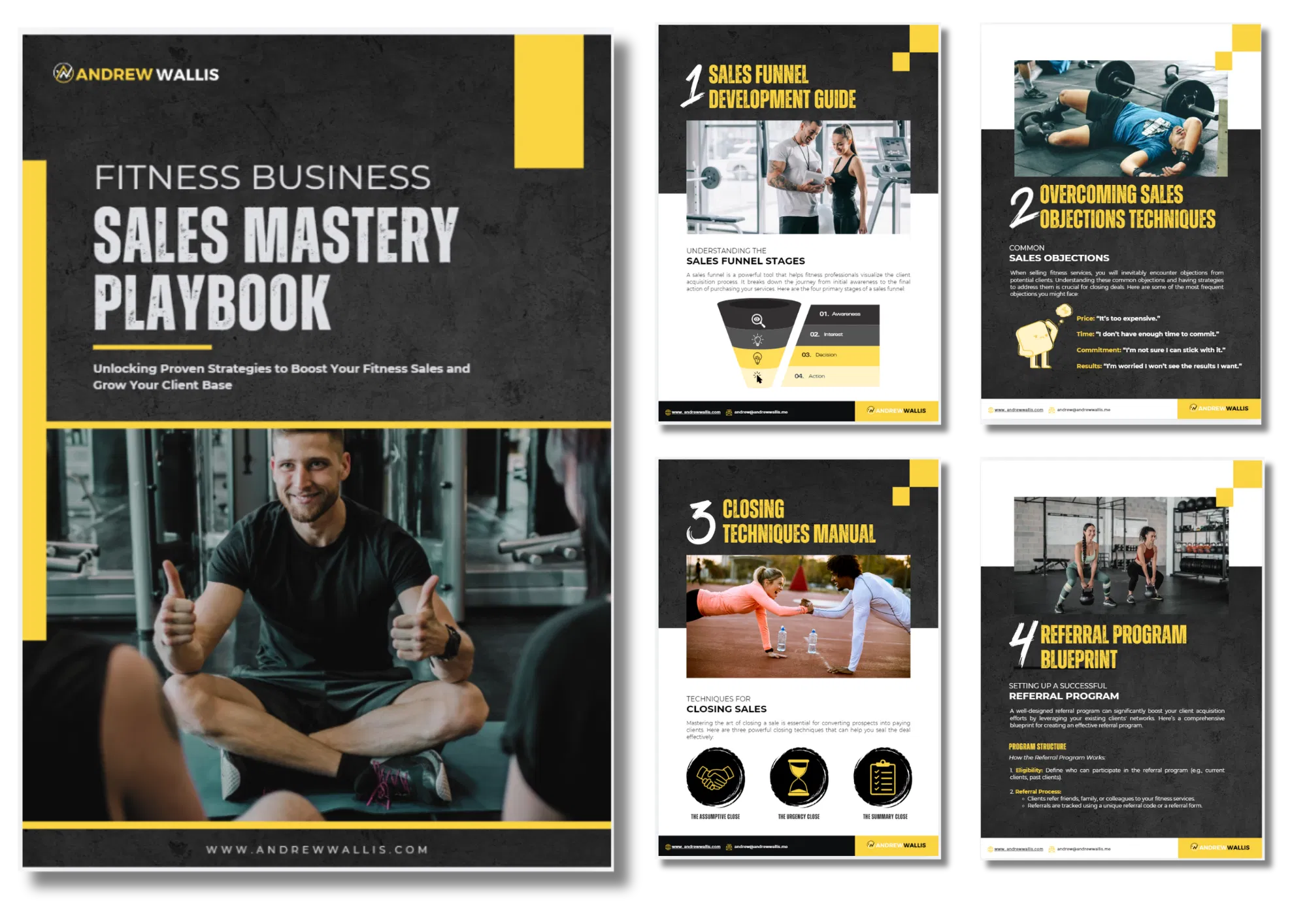
Once you have your custom roadmap from the Scorecard, you’ll need the right tools to build your engine. My Fitness Business Playbooks provide the exact templates and SOPs to fix your specific leaks—like my Sales Mastery Playbook which turns hesitant leads into committed clients.
Frequently Asked Questions (FAQ)
What is the Growth Engine OS?
The Growth Engine OS is a comprehensive business framework developed by Andrew Wallis Consultancy. It focuses on five pillars, WHO, FIND, START, STAY, and TRACK, to create a predictable and scalable fitness business.
Why is “Effort vs. Systems” important?
The “Effort vs. Systems” mantra highlights the difference between working in your business and working on it. Effort-based businesses rely on the founder’s manual labor, whereas system-based businesses use automated and documented processes to generate revenue.
How do I move from Stage 1 (Solo PT) to Stage 2 (Studio Owner)?
Transitioning requires a shift from being a generalist to a specialist. You must define a clear WHO, automate your lead generation (FIND), and begin documenting your processes so they can be performed by others.
What is the Andrew Wallis Growth Scorecard?
The Growth Engine Scorecard is a free diagnostic tool that allows fitness business owners to assess the health of their business across the five core pillars. It provides a customized report on how to fix “leaks” in your revenue engine.
Can one system really work for a PT and a Franchise?
Yes. While the scale and tools change, the fundamental human psychology of how people find a service, start a relationship, and stay as a client remains identical. We call this “One engine, multiple vehicles.”
About Andrew Wallis
Andrew Wallis is a Growth Architect and business consultant for the fitness industry. After years of navigating the transition from solo professional to business owner, he founded Andrew Wallis Consultancy to provide fitness professionals with a predictable roadmap to growth. By replacing “hustle” with the Growth Engine OS, Andrew helps owners reclaim their time and scale their impact.
Ready for a deeper dive? Book a Power Hour Coaching session with Andrew here.

