

Looking for the ultimate strategy for Google Business Profile for Fitness Businesses?
Are you still wasting three hours a day filming “trending” reels that get liked by people three time zones away, while your actual neighbours are clicking “Book Now” on your competitor’s profile?
If you’re relying on the social media hamster wheel to keep your studio doors open, you are fighting a losing battle. While you’re chasing the algorithm, local prospects are going to Google and searching for “personal trainer near me” or “best gym in [Your City].”
If you aren’t showing up there, you don’t exist.
Here is the reality of your current local marketing:
- You spend a fortune on a website that no one visits.
- You post daily on Instagram for zero enquiries.
- You hope “word of mouth” will save you (it won’t).
- You are invisible to the 76% of people who search for a local business and visit it within 24 hours.
Those days are long gone. The digital “high ground” has shifted.
In 2026, your Google Business Profile (GBP) is infinitely more important than your website or your social media feed. It is the primary engine for the FIND pillar of your business. If you want to stop being a “workhorse” and start building transferable revenue, you need to dominate local search.
WHAT: Why a Google Business Profile for Fitness Businesses is Your Digital Shop Front
For years, fitness professionals were told their website was the main thing. That’s outdated.
In 2026, your Google Business Profile is your digital shop front. It’s the first thing local people see when they search for a gym, studio, or coach near them. Before they visit your website. Before they scroll your Instagram. Before they ever send an enquiry.
That matters.
When somebody searches for “gym near me”, “personal trainer in [your town]”, or “Pilates studio nearby”, Google shows them your reviews, location, photos, opening times, and services right there in search. That means your GBP is not just a listing. It’s the front window of your business.
If your digital shop front looks weak, outdated, or incomplete, local prospects assume your business is too.
Before we go any further, you need to know exactly where your business stands. If your local lead flow is non-existent, it’s likely because your “FIND” system is broken.
Grab your results now with the Fitness Business Growth Scorecard
WHY: Google Business Profile for Fitness Businesses Powers the FIND Pillar
Here’s why this matters so much: Google Business Profile sits inside the FIND pillar of the Growth Engine. If people can’t find you, nothing else works. Not your content. Not your referrals. Not your offer.
No visibility means no pipeline.
Depending on your stage, the same system applies. If you’re a solo PT, your GBP helps local clients discover you. If you’re a studio owner, it drives class enquiries and trial bookings. If you’re running multiple locations, it gives each site its own local visibility. One engine → multiple vehicles.
But here’s the bigger play: a strong GBP helps you de-risk the business.
If your lead flow only works when you’re posting, chasing DMs, or constantly “showing up,” you’re still stuck in the Workhorse Trap. You’re the engine. That’s exhausting. It’s also fragile.
A high-ranking Google Business Profile is different. It’s an asset. It works when you’re coaching. It works when you’re off-site. It works when you’re on holiday. It keeps bringing in discovery, trust, and enquiries even when the owner isn’t there doing manual promotion.
That’s the shift from technician to Growth Architect.
And that’s how you start building transferable revenue—lead flow that belongs to the business, not just the owner’s daily effort. If you care about scaling, selling, stepping back, or simply Finding Your Freedom, this matters more than another week of random posting.
Why Google Business Profile for Fitness Businesses Beats Social Media for Local Leads
Social media can build awareness. Fine. But awareness isn’t the same as intent.
When somebody is scrolling Instagram, they’re distracted. They’re bored. They’re killing time. When somebody searches Google for “best gym near me”, they are actively looking for a solution. That’s a completely different buyer.
Here’s what happens instead:
- Social media interrupts attention whilst Google captures demand.
- Instagram followers can live anywhere whilst GBP traffic is local.
- Reels often bring vanity metrics whilst Google brings action-ready searches.
- Likes don’t fill classes whilst local search can drive calls, clicks, and directions.
That’s the vanity trap. One dashboard shows hearts and views. The other shows calls, website clicks, direction requests, and booked visits. One makes you feel busy. The other helps you build a real business.
That’s why successful fitness professionals who are winning in 2026 don’t rely on Instagram alone. They build a proper FIND system with GBP at the centre.
Andrew’s Insider Tip: If a marketing activity can’t produce a path to calls, visits, or enquiries, treat it with caution. Visibility is useful. Transferable revenue is better.
Why the Google 3-Pack matters so much
When Google shows the Local 3-Pack, it places three businesses at the top of the map results. That is the digital high ground. If you’re there, you get seen first. If you’re not, you’re often invisible.
Here’s the problem: most prospects never dig much deeper.
The 3-Pack matters because it puts your business in front of people who are ready now. They can call you. Get directions. Read your reviews. Visit your website. Book a session. All without leaving Google.
That’s why your GBP often outperforms your website for local lead generation. Google is trying to keep people on Google. You need to win inside that environment—not pretend it doesn’t exist.
And once you’re in that top 3 consistently, you’re not just getting leads. You’re building a local business asset your competitors have to work hard to displace. That’s strategic positioning. That’s de-risking. That’s what a Growth Architect focuses on.

Visual: A comparison showing a “Suspended” Google Profile vs. a “Verified/Optimized” one with clear branding.
If your local visibility is weak, don’t guess. Use the Fitness Business Growth Scorecard to spot the bottleneck in your FIND pillar.
HOW: Setting Up Your Google Business Profile for Fitness Businesses the Right Way
Most fitness businesses don’t have a lead problem. They have a setup problem. Their Google Business Profile is half-finished, inconsistent, or neglected. Then they wonder why the phone isn’t ringing.
Here’s how to fix it.
Step 1: Verify your profile properly
If your GBP isn’t verified, it’s basically not live in the way it needs to be. Go through Google’s verification process straight away. Follow the prompts. Complete the checks. Don’t leave it half-done for “later.” For official guidance, use the Google Business Profile Help resource as you work through setup and verification.
Later is why you’re losing local searches now.
Use your real business details. Use a legitimate address if you serve customers there. If you’re a service-area business, set it up properly rather than trying to game the system. Google is far more aggressive now with suspensions, and sloppy setup creates problems you don’t need.
In 2026, Google will often default to Video Verification. Don’t get caught off guard. Before you start recording, have your external signage, gym floor, equipment, and ID ready so you can get it done in one clean take. You want the process to look obvious, legitimate, and friction-free.
Andrew’s Insider Tip: Verification isn’t admin. It’s risk reduction. An unverified or fragile listing keeps you stuck in owner-dependence instead of building a business asset.
Step 2: Choose the right primary category
This is one of the biggest ranking signals you control. Your primary category tells Google what your business actually is.
Don’t get clever. Get clear.
If you are a gym, choose Gym. If you are a personal trainer, choose Personal Trainer. If you run a Pilates studio, choose Pilates Studio. Look at high-ranking competitors in your area and see what category they use. In most cases, the right move is obvious.
Then add relevant secondary categories only if they genuinely fit what you do.
Step 3: Lock in NAP consistency
NAP means Name, Address, and Phone Number. This must match across your website, directories, social profiles, and anywhere else your business appears online.
If your website says Unit 4, High Street and another listing says 4 High St, Google can read that as inconsistency. That weakens trust. And weak trust weakens rankings.
Keep it boring. Keep it identical.
Make one master version of your business details and use it everywhere. Same spelling. Same formatting. Same phone number. No shortcuts.
And don’t hide it. Your NAP on your website should ideally sit in the footer and on a dedicated Location page so Google’s crawlers can see it clearly. Make it painfully obvious. Ambiguity kills trust.
Step 4: Add photos that prove you’re real
Your profile needs visual proof. Not generic stock images. Not random graphics. Real photos of your space, your equipment, your team, your sessions, and the experience people can expect.
Upload:
- Exterior photos so people recognise the location
- Interior shots so the space feels familiar
- Team images to build trust
- Session photos that show your service in action
- Brand-led images that make the profile feel active and current
This is your digital shop front. Empty windows don’t attract buyers.
Profiles with fresh, relevant photos often get more engagement because prospects can picture themselves there before they ever visit.
Step 5: Build a simple review system
Reviews are not a “nice to have.” They are a core trust and prominence signal.
You need more reviews. You need better reviews. And you need recent reviews.
Here’s what to do:
- Ask every happy client at the right moment—after a win, a milestone, or a positive session.
- Make it easy by sending them your review link immediately.
- Ask them to mention the service they used and the result they got.
- Reply to every review with a genuine response that reinforces what you offer.
That last part matters. Your reply gives Google more context about your services, location, and relevance.
Pro Move: ask clients to upload a post-workout selfie or a quick shot of the gym floor with their review. Google loves user-generated images because they are high-trust signals. They make the review feel real, current, and far more believable than a plain text testimonial.
Advanced tactic: Keyword-stack your review replies
Most competitors waste review replies by writing “Thanks so much!” and moving on. That’s lazy.
Instead, use review replies to reinforce relevance. Mention the service. Mention the location. Mention the outcome naturally.
For example:
- “So glad you enjoyed our Small Group Personal Training in Manchester.”
- “Brilliant to hear the strength coaching sessions at our Leeds studio helped you feel more confident.”
- “Thanks for trusting us with your beginner fat-loss programme here in Liverpool.”
That’s what I call keyword-stacking. Not spam. Not stuffing. Just clear, natural reinforcement that helps Google better understand what you do and where you do it.
Andrew’s Insider Tip: Review replies are tiny SEO assets hiding in plain sight. Most fitness businesses ignore them. That’s exactly why you shouldn’t.
Step 6: Using Google Posts for Your Google Business Profile for Fitness Businesses
Most businesses either ignore Google Posts or dump the same bland update every month. That’s a miss.
Google Posts work like mini landing pages inside your profile. They give prospects a fresh reason to click, and they signal activity to Google’s AI. If your profile is active, complete, and relevant, you send stronger trust signals than the studio that hasn’t touched its listing since 2024.
Use Google Posts for:
- Intro offers like 7-day trials or consultation sessions
- Specific services like Small Group PT, bootcamps, or rehab sessions
- Seasonal pushes like summer challenges or January kickstarts
- Local proof like events, member wins, or community updates
Keep them short. Clear headline. One offer. One action.
Step 7: Optimise the service menu like a pro
This is the hidden ranking factor most competitors ignore.
Your Service Menu is not just for users. It helps Google understand the commercial intent behind your profile. If you only list your business name and a vague description, you’re leaving relevance on the table.
Instead, add each service individually:
- Personal Training
- Small Group Personal Training
- Bootcamp Classes
- Strength Coaching
- Nutrition Coaching
- Online Coaching
- Sports Massage if relevant
Then give each one a clear description using plain English. Explain what it is, who it’s for, and what result it helps with. If pricing is public, include it. If not, keep the description benefit-led and location-aware where appropriate.
This is one of those quiet moves that helps separate a serious local business from a half-built listing.
Step 8: Add attributes that help Google’s AI summarise your business
Most owners skip attributes because they look cosmetic. They’re not.
Add relevant attributes like Women-led, Veteran-led, and Accessibility features where they genuinely apply. These aren’t just labels. They are structured data points Google’s AI uses to understand and summarise your business in search results.
That matters more now.
When somebody searches with intent-heavy terms, or asks AI-powered search tools for a recommendation, those attribute signals can help your business match the query more clearly. If the attribute is true, add it. If it isn’t, don’t fake it.
Andrew’s Insider Tip: Attributes are tiny trust multipliers. Most competitors ignore them because they don’t look exciting. That’s exactly why they’re useful.
Step 9: Tracking Data for Your Google Business Profile for Fitness Businesses
If you’re still using Instagram likes as your benchmark, you’re measuring the wrong game.
Google Business Profile gives you signals that actually matter:
- Calls
- Website clicks
- Direction requests
- Profile views
- Search discovery
That data tells you whether your digital shop front is creating commercial activity. It tells you whether the FIND pillar is working. It helps you think like a Growth Architect, not a content hamster trapped in the Workhorse Trap.
Likes are nice. Direction requests are better.
Conversion move: Create a zero-friction Find-to-Book path
Getting found is only half the job. You also need to make booking stupidly easy.
Use the Book button on your Google Business Profile to link directly to your booking software—whether that’s PushPress, Glofox, MINDBODY, or another platform you already use. The goal is simple: reduce friction between discovery and action.
If somebody finds you, likes what they see, and is ready to move, don’t make them hunt around your website for the next step. Give them a clean Find to Book path.
That’s how local visibility turns into actual conversion.
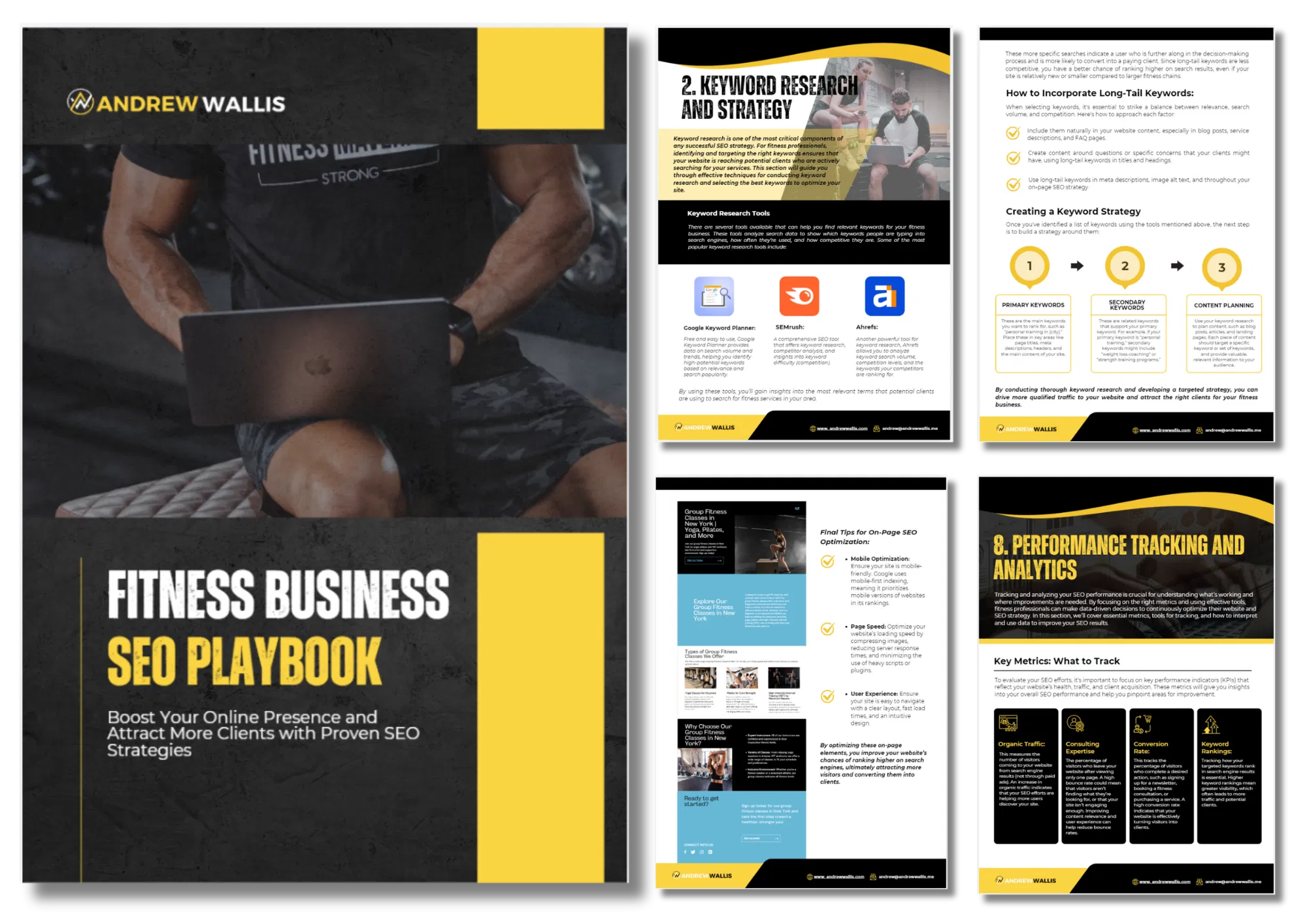
If you want the exact templates, prompts, and local SEO actions to tighten this up fast, the Fitness Business SEO Playbook will save you a pile of trial and error.
Grab the Fitness Business SEO Playbook today if you want the exact roadmap to turning local search into consistent lead flow.
NOW: Your Google Business Profile for Fitness Businesses 30-Minute Sprint
Stop procrastinating.
Seriously—stop telling yourself you’ll sort your Google Business Profile when things “calm down.” They won’t. And whilst you’re putting it off, other fitness businesses are taking the local searches that should be yours.
Here’s why this gets more urgent every month: local SEO is a compound interest game. The businesses sitting in the top 3 today keep stacking reviews, clicks, engagement, and trust signals. That momentum compounds. The longer you wait, the harder it is to catch them.
So no more waiting.
This is not a big branding project. This is not a six-week campaign. This is a 30-minute sprint.
Here’s what to do right now:
- Block 30 minutes in your calendar today.
- Log into your Google Business Profile.
- Check verification status—or prep your signage, equipment, and ID for Video Verification.
- Confirm your primary category.
- Audit your NAP against your website footer and Location page.
- Upload at least 5 real photos.
- Send 3 review requests before the day ends—and ask for one photo-review if possible.
- Publish 1 Google Post as a mini landing page.
- Add or clean up 3 services in your Service Menu.
- Add any relevant attributes like Women-led or Accessibility.
- Check your Book button links to your booking software properly.
That’s it.
Not perfect. Just done.
Most trainers and studio owners stay stuck because they wait until they have the perfect strategy, the perfect branding, or the perfect week. Meanwhile, the businesses that are winning simply take action on the boring stuff that actually drives leads.
This is one of those moves.
If you want to get out of the Workhorse Trap, stop building a business that depends entirely on your daily hustle. Build assets. Build systems. Build visibility that keeps working whilst you coach, sleep, or step away.
That’s how you start Finding Your Freedom.
Andrew’s Insider Tip: The first version does not need to be perfect. It needs to be live, complete, and improving. That’s how compound growth starts.

Grab the Fitness Business Client Acquisition Playbook today and get the exact roadmap to turning local search into consistent, high-paying clients.
Take the Fitness Business Growth Scorecard if you want to see exactly where your FIND system is leaking leads right now.
FAQ: Mastering Google Business Profile for Fitness Businesses
What is a Google Business Profile (GBP)?
A Google Business Profile is your digital shop front on Google Search and Maps. It shows local prospects your reviews, location, photos, services, and contact details before they ever visit your website.
What is the FIND pillar in the Growth Engine?
The FIND pillar is the part of the Growth Engine that helps people discover your business. It is about getting visible in the places local buyers are already searching—especially Google.
Why is Google Business Profile better than social media for local leads?
Google Business Profile is better for local leads because it captures active intent. People on Instagram are browsing. People on Google are usually looking for a solution right now. That’s also why GBP data like calls and direction requests matters more than vanity metrics like likes.
What is the Google 3-Pack?
The Google 3-Pack is the set of three local business listings shown near the top of map-based search results. It matters because those listings usually get the most visibility, clicks, calls, and directions.
How do I get into the Google 3-Pack?
You improve your chances by strengthening relevance, distance, and prominence. In practical terms, that means choosing the right category, keeping your NAP consistent, adding strong photos, getting reviews, optimising your Service Menu, and staying active with updates.
What is keyword-stacking in review replies?
Keyword-stacking in review replies is when you naturally mention the service and location in your response—for example, “So glad you enjoyed our Small Group Personal Training in Manchester.” It works because it reinforces relevance without sounding robotic.
What is a Google Post?
A Google Post is a short update published on your Google Business Profile. It acts like a mini landing page because it gives prospects a clear offer, update, or action step directly inside your listing.
What is the Service Menu on Google Business Profile?
The Service Menu is the section where you list and describe your services inside your GBP. It matters because it helps Google understand what you offer, which can improve relevance for local searches.
What are Google Business Profile attributes?
Attributes are profile labels such as Women-led, Veteran-led, or Accessibility features. They matter because Google’s AI can use them as data points when summarising and matching your business in search.
What is NAP consistency?
NAP consistency is when your Name, Address, and Phone Number appear exactly the same across your website, directories, and social platforms. It matters because inconsistent details can weaken Google’s trust in your business information. Ideally, that NAP should also be clearly visible in your website footer and on a dedicated Location page.
Why is my Google Business Profile suspended?
A Google Business Profile is often suspended because the setup looks untrustworthy to Google. Common causes include keyword stuffing in the business name, fake addresses, or inconsistent business information across the web.
What is Video Verification on Google Business Profile?
Video Verification is a method Google often uses in 2026 to confirm your business is legitimate. It usually works best when you can clearly show your signage, your premises, your equipment, and proof that you are connected to the business.
What is a photo-review?
A photo-review is a customer review that includes an image—like a post-workout selfie or a photo of the gym floor. It matters because user-generated images are strong trust signals and can make your profile look more active and credible.
How often should I update my Google Profile?
You should check it regularly, add fresh photos, request reviews consistently, respond to reviews quickly, and publish Google Posts often enough to show your profile is active. A neglected profile sends the wrong signals to both Google and your prospects.
About Andrew Wallis
Andrew Wallis is a business growth consultant dedicated to helping personal trainers and studio owners escape the “Workhorse Trap.” With decades of experience in the fitness industry, Andrew provides the frameworks and playbooks necessary to build a profitable, scalable, and sustainable fitness business that offers true freedom.
Ready to audit your local lead flow? Take the Growth Scorecard here.

